Horticultural Therapy Made Simple: Grow Wellness, Heal Your Mind

Xeriscaping: Amazing Ways to Save Water, Cut Costs & Stress
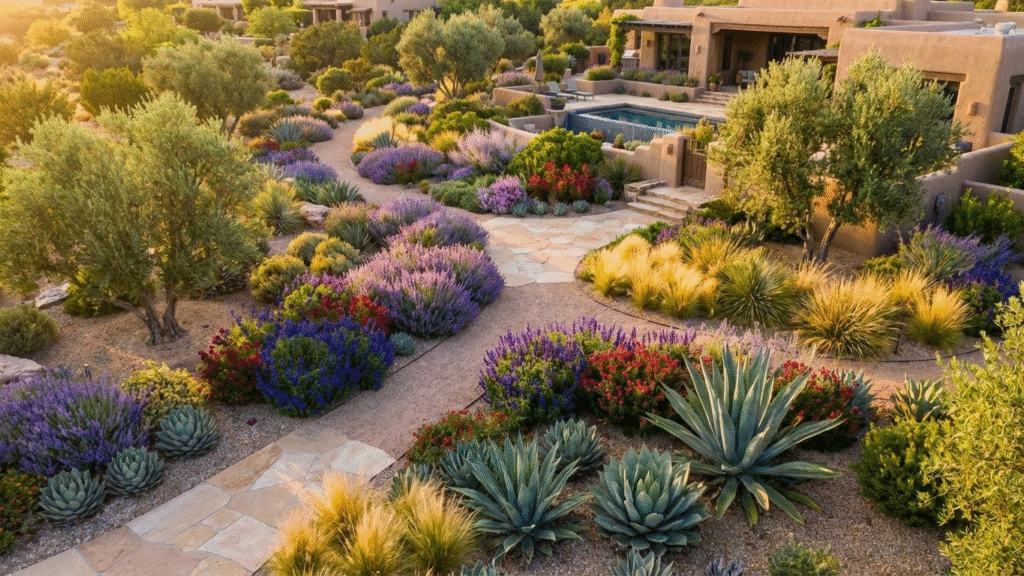
Table of Contents
I. Introduction: Is Xeriscaping the Anti-Stress Solution for Your Garden?
Picture this: It’s Saturday morning. You’re sipping coffee on your patio, watching butterflies dance around your garden. Instead of grabbing a hose and spending two hours watering, you’re simply… enjoying. No guilt. No rush. Just peace.
This isn’t a fantasy. It’s what xeriscaping offers thousands of gardeners who’ve discovered that less maintenance doesn’t mean less beauty. It means more time to actually live in your outdoor space instead of constantly working on it.
But here’s what most articles won’t tell you: xeriscaping isn’t just about saving water or cutting your utility bill (though it does both brilliantly). The real magic happens in your mind. When you design a garden that practically takes care of itself, you’re not just creating a landscape you’re building a refuge that supports your mental health instead of draining your energy.
Let’s explore how this water-wise approach—which allows you to save water, cut costs, and reclaim your time—might be the definitive stress-relief solution you’ve been searching for.
The Modern Gardener’s Paradox: More Watering = More Stress?
Traditional lawns demand constant attention. Miss a few days of watering in summer, and you’re staring at brown patches that scream “failure” to every neighbor who walks by. The pressure builds: water more, fertilize more, mow more, worry more.
According to the American Psychological Association, chronic low-level stressors—like maintaining a demanding lawn accumulate over time, contributing to anxiety and burnout. Your garden was supposed to be your escape. Instead, it became another obligation on your endless to-do list.
Xeriscaping flips this script entirely.
What Is Xeriscaping? Definition and Promise
Xeriscaping (pronounced “ZEER-ih-skay-ping”) comes from the Greek word “xeros,” meaning dry, combined with “landscaping.” It’s a method of designing gardens that need minimal water but it’s so much more than that.
Born in Denver, Colorado, during the 1981 drought, xeriscaping was created by Denver Water and landscape professionals as a response to water shortages. What started as crisis management has evolved into a philosophy: work with nature, not against it.
In environmental science, xeriscaping represents a sustainable approach to landscaping that respects regional climate, conserves resources, and reduces chemical inputs. The Environmental Protection Agency recognizes water-efficient landscaping as crucial for addressing water scarcity in the United States.
But here’s the promise that goes beyond environmental benefits: xeriscaping gives you permission to stop fighting your climate and start enjoying it.
💚 NIWAHEAL MOMENT
Did you know? Studies published in the Journal of Environmental Psychology show that spending 20 minutes planning your garden reduces cortisol (the stress hormone) as effectively as meditation. Xeriscaping, by simplifying design and maintenance, makes this benefit accessible even to complete beginners.
When your garden asks less of you, you can give more of yourself—to observation, creativity, and healing presence.
Xeriscaping vs. Traditional Landscaping: Beyond Water, Let’s Talk Time and Energy
Let’s be honest about what “traditional” landscaping actually demands:
Traditional Grass Lawn:
- Watering: 3-4 times weekly in summer
- Mowing: Weekly (1-2 hours)
- Fertilizing: 3-4 times yearly
- Weeding: Constant battle
- Worry level: High (vacation anxiety, drought guilt)
- Annual water usage: 15,000-20,000 gallons per 1,000 sq ft
Xeriscaped Garden:
- Watering: Occasional deep watering or rain-only
- Mowing: Minimal or none
- Fertilizing: Rarely needed
- Weeding: Reduced by 60-70% with mulch
- Worry level: Low (plants chosen to thrive, not just survive)
- Annual water usage: 3,000-5,000 gallons per 1,000 sq ft
According to Texas A&M AgriLife Extension, xeriscaping can reduce landscape water use by 50-75%. But the time savings? That’s the hidden treasure. Most xeriscaped gardens require 3-5 hours monthly versus 12-16 hours monthly for traditional landscapes.
That’s 84-132 hours returned to you every year. What would you do with an extra 11 vacation days?

II. The 7 Principles: Building Your Personal Refuge
The beauty of xeriscaping lies in its framework. Seven principles guide you from stressed-out lawn warrior to relaxed garden observer. Each principle isn’t just a technique—it’s a step toward mental freedom.
The 7 Principles Explained (and Why Each One Reduces Stress)
The Colorado State University Extension outlines these seven principles as the foundation of water-wise landscaping. But let’s look at what they really do for your wellbeing:
- Planning and Design – You create instead of react
- Soil Improvement – You build a foundation that works
- Appropriate Plant Selection – You choose allies, not dependents
- Practical Turf Areas – You limit the demanding zones
- Efficient Irrigation – You water smarter, not harder
- Mulch – You protect against unpredictability
- Appropriate Maintenance – You maintain relationships, not emergencies
Let’s dive into the most impactful principles.
Principle #1: Planning & Design – The Calming Act of Creation
Before you buy a single plant, you draw. You dream. You imagine.
This isn’t busywork it’s therapy disguised as planning. Research in the Journal of Therapeutic Horticulture confirms that the act of designing outdoor spaces activates the brain’s reward centers, releasing dopamine. You’re literally getting a happiness boost from thinking about your future garden.
How to design your xeriscape:
- Map your space – Note sun exposure (6+ hours = full sun), slopes, and existing features
- Create zones – High-use areas near the house, low-water zones farther out
- Choose a style – Desert modern, Mediterranean, native prairie, or succulent showcase
- Sketch pathways – Make your garden explorable, inviting movement and discovery
The stress-reduction secret? Planning gives you control. Instead of reacting to dying plants, you’re proactively creating an ecosystem designed for your climate.
💚 NIWAHEAL MOMENT
Creating is healing. When you design your xeriscape, you’re not just arranging plants—you’re declaring, “This is my space, and I’m making it work for me.” That sense of agency, of authorship over your environment, is profoundly therapeutic. It’s why horticultural therapy has become a recognized treatment for anxiety and depression.
Principle #2: Mulch – Your Shield Against the Unpredictable
Life is unpredictable. Your garden doesn’t have to be.
A 3-4 inch layer of organic mulch (wood chips, bark, or compost) or inorganic mulch (gravel, decomposed granite) acts as your garden’s insurance policy:
- Retains moisture – Reduces watering frequency by 50%
- Regulates temperature – Keeps roots cool in summer, warm in winter
- Suppresses weeds – Cuts weeding time by 60-70%
- Looks finished – Creates cohesive aesthetic immediately
But psychologically? Mulch is your permission slip to stop micromanaging. You’ve created a buffer between your plants and chaos. When a heatwave hits, you’re not panic-watering every evening. Your mulch layer is doing the work.
The University of California Agriculture and Natural Resources confirms that mulch is the single most cost-effective water conservation strategy in landscaping.
Principle #3: Efficient Irrigation – Freedom Regained
Here’s a radical idea: what if you watered once or twice a week instead of daily?
Traditional sprinklers spray water everywhere (including sidewalks and driveways), encouraging shallow root growth that makes plants dependent on frequent watering. They’re also expensive to run adding $50-150 monthly to summer utility bills.
Drip irrigation or soaker hoses deliver water directly to roots, reducing waste by 30-50% according to the EPA WaterSense program. Better yet, you can add an inexpensive timer and forget about it.
But let’s talk about the psychological shift: Freedom from irrigation anxiety.
No more rushing home from work to water before dark. No more canceling plans because “the garden needs me.” No more vacation stress wondering if your plants will survive. Your efficient system handles it, or your drought-tolerant plants simply wait for the next rain.
One xeriscaper shared: “I went on a two-week vacation without arranging plant care. I came home to a thriving garden. For the first time in 15 years of gardening, I truly relaxed on vacation.”
Principles #4-7: Your Complete Autonomy Toolkit
Soil Improvement – Adding compost increases water retention, meaning less frequent watering. Healthy soil = low-maintenance plants.
Practical Turf Areas – Limit grass to where it’s actually used (kids’ play area, pet zone). Replace ornamental lawn with groundcovers, gravel paths, or mulched beds. Every square foot of grass removed saves 60-80 gallons of water annually.
Appropriate Plant Selection – Choose plants adapted to your climate (more on this below). Native and adapted plants evolved to handle local conditions without constant human intervention.
Appropriate Maintenance – Notice that word: “appropriate,” not “intensive.” Xeriscape maintenance is seasonal: spring cleanup, occasional pruning, annual mulch replenishment. You’re stewarding, not rescuing.

III. Plant Selection: Your Resilience Partners
Plants aren’t just decorations. In xeriscaping, they’re your collaborators chosen specifically because they want to thrive in your conditions.
What Plants Make for a Calming Xeriscape Garden?
The best xeriscape plants share three qualities:
- Low water needs – Once established, they survive on natural rainfall
- High stress tolerance – They handle heat, cold, poor soil, and neglect
- Year-round interest – Evergreen foliage, unique textures, or seasonal blooms
Top Xeriscape Plants by Region:
Southwest (Arizona, New Mexico, Southern California):
- Agave species (architectural drama)
- Desert marigold (cheerful yellow blooms)
- Penstemon (hummingbird magnet)
- Mexican feather grass (movement and softness)
- Ocotillo (sculptural statement)
Southeast (Texas, Florida, Georgia):
- Muhly grass (pink fall plumes)
- Yucca (bold evergreen)
- Black-eyed Susan (native pollinator plant)
- Lantana (continuous blooms, heat-lover)
- Southern wax myrtle (privacy screen)
Mountain West (Colorado, Utah, New Mexico):
- Blue grama grass (native prairie grass)
- Pinyon pine (evergreen structure)
- Apache plume (white flowers, pink seed heads)
- Blanket flower (fire-colored blooms)
- Chamisa (golden fall color)
Pacific Northwest (Oregon, Washington):
- Sedum species (succulent groundcovers)
- Lavender (fragrant, pollinator-friendly)
- Salvia (drought-tough once established)
- Ornamental oregano (edible beauty)
- Rockrose (Mediterranean charm)
Midwest/Great Plains:
- Little bluestem (ornamental native grass)
- Coneflower (purple, white, or coral)
- Russian sage (silvery texture)
- Yarrow (low-water perennial)
- Switchgrass (vertical accent)
The Lady Bird Johnson Wildflower Center offers a free native plant database where you can search by zip code for species perfectly adapted to your location.
Water-Guzzling Plants vs. Xeric Plants: Choosing Serenity
Let’s be clear: some plants are high-maintenance relationships. They need constant attention, specific conditions, and they’ll punish you with wilt and decline if you miss a watering.
Plants that demand the most water:
- Hydrangeas (up to 2 inches weekly)
- Impatiens (daily watering in heat)
- Traditional lawns (1-2 inches weekly)
- Azaleas (consistent moisture)
- Hostas (wilt dramatically when dry)
These aren’t bad plants they’re just incompatible with low-stress gardening in dry climates.
Xeric plants that offer peace of mind:
- Sedums (store water in leaves)
- Lavender (Mediterranean native, loves neglect)
- Yarrow (survives on 10 inches annual rainfall)
- Ornamental grasses (deep roots tap into groundwater)
- Agaves and yucca (can survive months without rain)
The psychological difference is profound. Water-loving plants train you to be hypervigilant, always checking, always worried. Xeric plants train you to trust—to observe changes slowly, to let nature take the lead.
Sensory Garden Design: Xeric Plants for All Five Senses
Horticultural therapy recognizes that engaging multiple senses deepens the healing benefits of gardens. Your xeriscape can be a full sensory experience:
Touch:
- Lamb’s ear (Stachys byzantina) – Impossibly soft leaves
- Ornamental grasses – Satisfying rustle through fingers
- Succulents – Smooth, cool, and firm
Smell:
- Lavender – Calming, sleep-inducing
- Russian sage – Aromatic when brushed
- Rosemary – Invigorating, memory-enhancing
Sight:
- Penstemon – Tubular flowers in jewel tones
- Sedum ‘Autumn Joy’ – Pink flowers aging to rust
- Blue fescue – Steel-blue tufts of grass
Sound:
- Bamboo muhly – Whispers in the breeze
- Fountain grass – Gentle rustling
- Pampas grass – Dramatic swaying and shushing
Taste (edible xeriscapes):
- Rosemary – Drought-tolerant herb
- Thyme – Groundcover you can harvest
- Mediterranean oregano – Flavorful and low-water
A study in HortTechnology found that sensory gardens specifically designed with texture, scent, and sound reduced anxiety scores by 37% in participants over eight weeks.
💚 NIWAHEAL MOMENT
Your plants reflect your values. Choosing drought-tolerant species isn’t just practical—it’s an act of alignment. You’re saying, “I respect my climate. I work with nature, not against it.” That alignment between values and actions creates what psychologists call “congruence,” a key component of wellbeing and reduced eco-anxiety.
Where to Buy Your Xeriscape Plants
Local nurseries specializing in native plants – These are goldmines. Staff know what thrives locally and can offer maintenance tips.
State native plant societies – Most states have organizations that sell native seeds and plants at seasonal sales. Search “[Your State] Native Plant Society.”
Online specialists:
- High Country Gardens (xeriscaping specialists)
- Prairie Moon Nursery (native seeds and plants)
- Mountain Crest Gardens (succulents and xeric plants)
Big-box stores – Available but limited selection. Look for plants labeled “drought-tolerant” or “water-wise.”
Pro tip: Buy small. Xeric plants establish better from 4-inch pots than from gallons. They’re cheaper, adapt faster, and you’ll feel less guilt if you experiment and something doesn’t work.

IV. The Economic Equation: Investing in Your Peace of Mind
Let’s talk money because financial stress and garden stress compound each other.
Is Xeriscaping Worth It? An Honest Analysis
Upfront costs (for 1,000 sq ft garden conversion):
- Removing existing lawn: $1-2 per sq ft ($1,000-2,000)
- Soil amendment: $200-400
- Drip irrigation installation: $300-600
- Mulch (3-inch layer): $150-300
- Plants (25-30 plants): $300-600
- Total: $1,950-3,900
Sounds steep. But now the returns:
Annual savings:
- Water bill reduction: $300-600 (50-75% reduction)
- Lawn care products eliminated: $200-400
- Mowing costs (service or gas): $500-1,200
- Total annual savings: $1,000-2,200
Payback period: 2-4 years. After that, pure savings.
But here’s what spreadsheets miss: peace of mind has no price tag.
A 2023 survey by the National Gardening Association found that gardeners cited “stress relief” as their top motivation above food production or aesthetics. Xeriscapers reported 40% less “garden-related stress” than traditional gardeners.
What’s it worth to stop worrying about water bills? To skip the guilt of watching your lawn die during droughts? To never panic about vacation plant care?
Cost Breakdown: Xeriscaping vs. Traditional Lawn (10-Year Comparison)
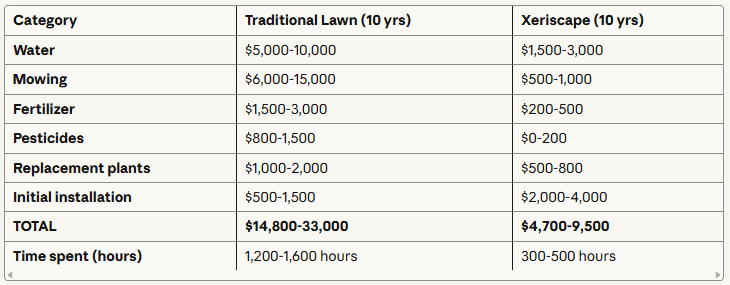
You save: $10,000-23,000 and 700-1,100 hours over a decade.
That’s two months of full-time work returned to your life. Use it for vacations, hobbies, family time, or simply sitting in your beautiful, self-sufficient garden.
The Disadvantages: What Nobody Tells You
Honesty builds trust. Here’s what can go wrong:
1. Learning curve – You might kill plants while figuring out what works. (Spoiler: Everyone does. Those $3 starter plants are your tuition.)
2. Aesthetic adjustment – Neighbors raised on green lawns might not “get it” initially. Xeric gardens look different and that’s the point.
3. Initial cost – That $2,000-4,000 upfront investment is real. DIY can cut costs by 50%, but requires sweat equity.
4. Not instant gratification – Xeric plants often start small and take 1-3 years to reach mature size. Patience required.
5. Less green – If you psychologically need a sea of emerald green, xeriscaping requires retraining your eye to appreciate silver, blue, rust, and gold.
The University of Nevada Cooperative Extension notes that homeowner perception is the biggest barrier to xeriscaping adoption not actual performance issues.
Property Value: Does Xeriscaping Help or Hurt?
The data surprises most people.
A Texas A&M study found that mature xeriscapes increase property values by 15-20% in water-scarce regions. Buyers increasingly value:
- Lower utility costs
- Reduced maintenance requirements
- Eco-friendly features
- Unique curb appeal
However, in regions with water abundance (Pacific Northwest, Northeast), the impact is neutral neither increasing nor decreasing value significantly.
The key: Professional design and mature plants. A scraggly pile of rocks decreases value. A thoughtfully designed xeriscape with established plants and clear structure increases it.
But here’s the real question: What’s the value of your time and sanity worth?
If you love maintaining a lawn, keep it. If you resent every hour spent mowing and every dollar spent watering, xeriscaping is priceless.

V. The Real Advantage: Rediscovering the Joy of Gardening
Here’s where we talk about what really matters your wellbeing.
How Much Time Do You Spend Suffering Your Garden?
Be honest. Grab a piece of paper and calculate:
Traditional lawn weekly time commitment (summer):
- Mowing: 1-2 hours
- Edging: 20-30 minutes
- Watering (moving sprinklers): 2-3 hours
- Weeding: 30-60 minutes
- Fertilizing (seasonal): 1 hour every 6 weeks
- Total: 4-7 hours weekly (200-350 hours annually)
Xeriscape weekly time commitment (summer):
- Watering (drip system check): 10-15 minutes
- Weeding (reduced by mulch): 15-20 minutes
- Pruning/deadheading: 20-30 minutes
- Seasonal tasks (quarterly): 2-3 hours per season
- Total: 1-2 hours weekly (50-100 hours annually)
You reclaim: 150-250 hours per year.
That’s six full days. What if, instead of edging your lawn for the 47th time this year, you were reading in a hammock strung between two drought-tolerant trees you planted? What if you were watching goldfinches feast on coneflower seeds instead of refilling sprinklers?
The Myth of the Perfect Lawn: Why We Exhaust Ourselves
American lawn culture is rooted in 1950s suburbia a time of cheap water, cheap gas, and cultural pressure to conform. The “perfect lawn” became a status symbol, a sign of diligence and success.
But it was always a lie.
Ecological truth: Grass lawns are non-native monocultures requiring constant inputs. The NASA Climate Change study notes that lawn irrigation accounts for nearly 9 billion gallons of water daily in the U.S. much of it in regions facing severe drought.
Psychological truth: The perfect lawn is a moving target. There’s always another dandelion, another brown patch, another thing to fix. It trains you in dissatisfaction teaching you to see flaws instead of beauty.
Xeriscaping invites a different mindset: Good enough is beautiful. Your garden is meant to be a living ecosystem, not a golf course. Imperfection is authenticity.
Horticultural Therapy Explained: The Science of “Liberating Gardening”
Horticultural therapy (HT) is an established practice used in hospitals, rehabilitation centers, and mental health facilities. It leverages the human-plant relationship to improve psychological wellbeing.
Research published in the Journal of Health Psychology shows gardening activities:
- Lower cortisol by 11-18%
- Improve mood scores by 25-33%
- Increase feelings of self-efficacy and accomplishment
- Provide gentle physical activity
- Offer sensory stimulation that grounds anxious minds
But here’s the catch: only certain types of gardening deliver these benefits.
Gardening that feels like punishment (forced maintenance, deadline pressure, fear of failure) increases stress. Gardening that feels like play (creative design, discovery, nurturing) decreases stress.
Xeriscaping tips the scale toward play. When your plants don’t need rescuing, you can be present with them. You observe growth instead of managing crisis. You create instead of reacting.
💚 NIWAHEAL MOMENT
The concept of “green mental load” – Just as we talk about mental load in household management (the invisible planning and worry), gardens create their own mental load. Every plant that needs daily watering is an item on your cognitive to-do list. Every brown spot on your lawn is a visual reminder of failure.
Xeriscaping reduces green mental load by 60-80%. Your garden stops being a source of obligations and becomes, finally, a refuge.
Real Story: From Burnout to Garden Zen
“I’m a teacher. My summers were supposed to be restful, but I spent them enslaved to my lawn. Two hours every evening watering. Saturdays mowing. I was exhausted and resentful.
After a particularly brutal summer where my water bill hit $400 monthly, I ripped out 80% of my grass. I planted lavender, Russian sage, ornamental grasses, and covered everything with gravel mulch.
The first summer after, I kept walking outside with the hose out of habit then realizing I didn’t need it. It took months to deprogram myself from the anxiety.
Now, three years later, my garden is full and gorgeous. I spend maybe 30 minutes weekly just deadheading and tidying. The rest of the time? I read on my patio. I watch bees. I actually enjoy my yard instead of dreading it.
My therapist asked what changed in my life because my anxiety scores dropped. It was the garden. Xeriscaping gave me back my summers and my sanity.”
Sarah M., Albuquerque, NM
Quiz: Is Your Garden a Source of Stress?
Answer yes or no:
- Do you feel guilty when you see brown spots in your lawn?
- Do you worry about your plants when you’re on vacation?
- Do you spend more than 5 hours weekly on garden maintenance?
- Does your summer water bill cause anxiety?
- Do you avoid having friends over because your yard isn’t “ready”?
- Do you feel like your garden is always behind schedule?
- Have you ever described gardening as “exhausting” or “overwhelming”?
- Do you fantasize about replacing your entire yard with artificial turf or gravel?
0-2 yes: You’re managing well, but xeriscaping could still free up time.
3-5 yes: Your garden is a significant stressor. Xeriscaping would dramatically improve your quality of life.
6-8 yes: Your garden has become a burden. It’s time for a complete reset. Xeriscaping isn’t optional it’s necessary for your wellbeing.
VI. Taking Action: Your Roadmap to Serenity
You’re convinced. Now what?
Summary: The Three Pillars of Xeriscaping
Let’s crystallize what we’ve learned:
Pillar 1: Ecological Wisdom
- Work with your climate, not against it
- Choose plants that want to thrive in your conditions
- Conserve water as a moral and practical choice
Pillar 2: Economic Sense
- Reduce water, maintenance, and product costs by 50-70%
- Invest upfront for 30+ years of savings
- Increase property value in water-conscious markets
Pillar 3: Mental Equilibrium
- Reduce garden-related stress by 40%+
- Reclaim 150-250 hours annually
- Transform your relationship with your outdoor space from obligation to joy
These pillars support each other. You can’t have one without the others. That’s what makes xeriscaping a holistic solution it works on every level.
Week 1-4: Your Transformation Plan
Week 1: Observe and Document
- Take photos of your current space
- Note sun patterns throughout the day
- Identify your biggest garden stressors (watering? mowing? weeding?)
- Research your USDA hardiness zone and annual rainfall
Week 2: Design and Dream
- Sketch your ideal xeriscape (even if you can’t draw stick figures work)
- Browse Pinterest, Instagram (#xeriscaping), and Houzz for inspiration
- Visit local xeriscapes (many water utilities offer free tours)
- Choose your aesthetic: desert modern, cottage rustic, native prairie, succulent showcase
Week 3: Start Small
- Pick ONE high-visibility area (usually front yard or patio edge)
- Remove a 100-200 sq ft section of lawn
- Improve soil with 2-3 inches of compost
- Lay down landscape fabric and add 3-4 inches of mulch
- Plant 5-10 xeric plants (choose species from the lists above)
Week 4: Install Irrigation (Optional but Recommended)
- Set up a simple drip system with a timer
- Or commit to deep watering once weekly with a hose
- Enjoy your first xeric garden bed!
Month 2-6: Repeat the process, expanding gradually. Most gardeners find that starting small builds confidence and allows you to learn what thrives before investing heavily.
Checklist: 30-Day Xeriscape Kickstart
Pre-Planning:
☐ Calculate current water usage (check 3 months of bills)
☐ Photograph existing landscape from 4 angles
☐ Research native/adapted plants for your zip code
☐ Set budget ($500? $2,000? $5,000?)
Design Phase:
☐ Sketch rough garden layout
☐ Mark sun/shade zones on sketch
☐ Decide: DIY or hire designer for plan?
☐ Select 10-15 plant species for first phase
☐ Choose mulch type (organic vs. inorganic)
Installation Phase:
☐ Rent sod cutter or mark lawn for removal
☐ Remove grass (rent equipment or hire labor)
☐ Amend soil with compost
☐ Install drip irrigation or soaker hoses
☐ Add plants (space properly for mature size)
☐ Mulch thoroughly (3-4 inches)
☐ Water deeply to establish roots
Maintenance Phase:
☐ Water deeply twice weekly for first month
☐ Reduce to weekly watering month 2-3
☐ Transition to rain-only or bi-weekly by month 6
☐ Add mulch annually to maintain 3-inch depth
☐ Prune/divide perennials as needed
Conclusion: Your Xeriscaping Journey Starts With One Small Step
Xeriscaping isn’t just a landscaping trend it’s a complete reimagining of how we relate to our outdoor spaces. After exploring the seven principles, understanding the costs, and discovering the profound stress-relief benefits, one truth becomes crystal clear: xeriscaping transforms gardens from demanding obligations into healing sanctuaries.
The Ecological Impact: Your Garden as Climate Solution
Every xeriscape garden you create becomes a powerful act of environmental stewardship. By reducing water consumption by 50-75%, you’re directly addressing the water scarcity crisis affecting millions across North America. According to the EPA, residential outdoor water use accounts for nearly 9 billion gallons daily in the United States much of it wasted on non-native lawns struggling against their climate.
When you choose drought-tolerant native plants over thirsty grass, you’re doing so much more than saving water:
🌍 Ecological Benefits of Xeriscaping:
- Biodiversity support – Native plants provide habitat for local pollinators, birds, and beneficial insects that traditional lawns exclude
- Soil health restoration – Deep-rooted xeric plants prevent erosion, improve soil structure, and require zero chemical fertilizers that contaminate groundwater
- Carbon sequestration – Established perennials and native grasses store more carbon than frequently-mowed lawns
- Reduced pollution – Eliminating gas-powered mowers, chemical pesticides, and synthetic fertilizers means cleaner air and water for your entire community
- Microclimate improvement – Diverse plantings moderate temperature extremes, providing cooling effects without energy-intensive irrigation
Research published in Landscape and Urban Planning confirms that water-wise landscapes reduce the urban heat island effect by 5-7°F compared to traditional turf. Your personal xeriscaping choice ripples outward, contributing to healthier ecosystems and a more resilient environment for future generations.
The Economic Liberation: Invest Once, Save Forever
Let’s talk about the money because financial freedom and garden freedom go hand in hand. The initial xeriscaping investment of $2,000-4,000 might seem substantial, but it’s one of the smartest financial decisions you’ll ever make for your home.
💰 Your 10-Year Xeriscaping Return on Investment:
- Water bill savings: $3,000-6,000 (50-75% reduction annually)
- Eliminated lawn care costs: $5,000-12,000 (mowing, fertilizing, pesticides)
- Reduced replacement plants: $1,000-1,500 (hardy plants survive vs. annual replacements)
- Increased property value: 15-20% boost in water-scarce regions (Texas A&M study)
- Total savings over 10 years: $10,000-23,000
But the hidden economic benefit runs even deeper. By reclaiming 150-250 hours annually that you’d otherwise spend on lawn maintenance, you’re essentially giving yourself 3-6 weeks of vacation time every single year. What’s that time worth to you? To spend with family? To pursue hobbies? To simply rest?
Xeriscaping delivers what economists call a “triple bottom line” good for your wallet, good for the planet, and good for your quality of life.
The Therapeutic Revolution: Horticultural Therapy Meets Sustainable Design
Here’s where xeriscaping reveals its most profound gift the transformation of your mental and emotional wellbeing. Research in horticultural therapy has consistently demonstrated that gardens reduce anxiety, lower cortisol levels, and improve mood. But not all gardens deliver these benefits equally.
Traditional high-maintenance lawns create what we call “green mental load” the invisible cognitive burden of constant garden worry. Every brown patch becomes a visual reminder of failure. Every vacation requires plant-sitting arrangements. Every heat wave triggers watering anxiety. This chronic low-level stress accumulates, contributing to burnout and diminished life satisfaction.
🌱 Xeriscaping’s Therapeutic Benefits:
Mental Health Improvements:
- Reduced anxiety – Studies show horticultural therapy activities lower anxiety scores by 25-37% (Journal of Health Psychology)
- Decreased depression symptoms – Engaging with self-sufficient gardens provides accomplishment without pressure
- Improved cognitive function – Planning and designing xeriscapes activates creative problem-solving and boosts dopamine
- Enhanced sense of control – Working with climate rather than fighting it restores feelings of competence and mastery
Physical Wellbeing:
- Gentle exercise – Occasional weeding and pruning provide movement without exhausting labor
- Sensory stimulation – Touching lamb’s ear, smelling lavender, watching grasses sway engages all five senses
- Outdoor time – More garden enjoyment means more vitamin D, fresh air, and connection to nature’s rhythms
- Reduced exposure to chemicals – No pesticides or synthetic fertilizers means healthier air quality for your family
Social and Emotional Benefits:
- Pride and confidence – A thriving xeriscape demonstrates your success working with nature
- Conversation starter – Unique gardens invite neighbor curiosity and build community connections
- Values alignment – Living in ecological integrity reduces eco-anxiety and moral distress
- Time for relationships – Hours saved on maintenance become hours invested in what matters most
The American Horticultural Therapy Association recognizes that gardens designed for low-maintenance and high sensory engagement deliver the most consistent therapeutic benefits. Xeriscaping checks both boxes beautifully.
Your Xeriscape Garden: A Legacy of Wisdom
When you transform your lawn into a xeriscape, you’re not just changing plants you’re modeling a different relationship with the natural world. You’re demonstrating that beauty doesn’t require conquest, that abundance can emerge from simplicity, and that working with nature is always more rewarding than working against it.
Your drought-tolerant garden becomes a teaching tool for neighbors, a refuge for local wildlife, and a testament to intelligent design. Children growing up with xeriscapes learn that “green” doesn’t always mean grass, that water is precious, and that diverse ecosystems are more resilient than monocultures.
Take Action: Begin Your Transformation This Week
Xeriscaping isn’t an all-or-nothing proposition. You don’t need to rip out your entire yard this weekend. Start with one high-visibility area perhaps a 100-square-foot section near your front entrance or a neglected side yard. Follow the simple four-week plan outlined earlier:
Week 1: Observe your space, document sun patterns, and dream about possibilities
Week 2: Design your first xeriscape bed with native plants suited to your region
Week 3: Remove existing lawn, improve soil, and install your drought-tolerant plants
Week 4: Set up efficient irrigation and add mulch protection
That single small success will build your confidence and demonstrate the dramatic difference xeriscaping makes not just in your garden, but in your daily life.
The Future is Water-Wise: Join the Movement
Climate change means water scarcity will intensify across North America in coming decades. Xeriscaping isn’t a temporary trend it’s the future of residential landscaping. Early adopters enjoy not only immediate benefits but also positioning themselves ahead of potential water restrictions, rising utility costs, and shifting property value dynamics.
Water utilities across the Southwest, Mountain West, and increasingly in the Midwest offer rebates and incentives for xeriscaping conversions essentially paying you to make this transformation. Visit your local water district website to discover available programs that can offset 30-50% of your installation costs.
Final Thoughts: From Stress to Serenity
Remember that Saturday morning we imagined at the beginning? The one where you’re sipping coffee, watching butterflies dance through your garden, completely free from watering duty and lawn guilt? That future is entirely achievable. Thousands of gardeners have already made this shift—from exhausted lawn warriors to relaxed garden observers.
Xeriscaping saves water. It saves money. It saves time. But most importantly, it saves your sanity and restores your joy in outdoor spaces. Your garden should be a refuge, not a responsibility a place that gives back far more than it demands.
The question isn’t whether xeriscaping is worth it. The real question is: How much longer will you wait to reclaim your time, reduce your stress, and create a garden that actually works for you instead of against you?
Your xeriscape journey begins with a single decision: to work with nature, honor your climate, and choose serenity over struggle. Everything beautiful grows from there.
Scientific Resources Referenced
- American Psychological Association – Stress Effects
- Environmental Protection Agency – WaterSense Landscapes
- Journal of Environmental Psychology
- Texas A&M AgriLife Extension – Xeriscaping
- Colorado State University Extension – Xeriscaping Principles
- Journal of Therapeutic Horticulture
- American Horticultural Therapy Association
- University of California Agriculture and Natural Resources
- Lady Bird Johnson Wildflower Center – Native Plant Database
- HortTechnology Journal
- National Gardening Association
- University of Nevada Cooperative Extension
- NASA Climate Change Research
- Journal of Health Psychology