Horticultural Therapy Made Simple: Grow Wellness, Heal Your Mind

Can’t Sleep? 7 Plants & Garden Rituals Proven to Fix Insomnia

Table of Contents
NTRODUCTION
It’s 2:47 AM.
You’re staring at the ceiling again. Your mind is racing through tomorrow’s to-do list, replaying that awkward conversation from Tuesday, calculating how many hours of sleep you’ll get if you fall asleep right now.
You won’t.
You already know that.
So you reach for your phone. You scroll. The blue light makes everything worse. By morning, you’ll drag yourself through another day running on caffeine and willpower — feeling like a shadow of the woman you actually are.
You’re not alone in this.
According to the American Sleep Association, approximately 70 million Americans suffer from chronic sleep disorders. Insomnia alone affects roughly 30% of adults in North America, with women being 40% more likely to experience it than men, according to research published in the Journal of Clinical Sleep Medicine.
And yet, the most common solution — sleeping pills — comes with a troubling list of side effects. Research from the National Institutes of Health links long-term sedative use to dependency, morning grogginess, cognitive impairment, and even increased fall risk.
But what if the answer wasn’t in your medicine cabinet?
What if it was growing quietly on your windowsill?
Emerging research from institutions including NASA, the University of Kagoshima, and Wheeling Jesuit University suggests that specific plants — placed strategically in your bedroom — can reduce anxiety, purify your air, and release oxygen at night, creating the biological conditions your body needs to fall asleep naturally and stay asleep deeply.
No pills. No side effects. No dependency.
In this article, you’ll discover:
- The 3 scientific mechanisms through which plants trigger sleep
- 7 specific plants ranked by research evidence, with exact placement instructions
- A 30-minute evening garden ritual that research suggests may outperform melatonin supplements
- A step-by-step bedroom blueprint you can implement tonight
- A 7-day Sleep Garden Challenge to transform your nights
Let your bedroom become the pharmacy that nature intended.
Why Your Brain Won’t Let You Sleep (And How Plants Change That)
The Stress-Sleep Vicious Cycle Your Body Is Trapped In
Here’s what’s happening inside your body every night when sleep refuses to come.
Your hypothalamic-pituitary-adrenal (HPA) axis — the stress command center of your brain — is stuck in “threat mode.” According to research published in Sleep Science, when cortisol levels remain elevated at night, your brain interprets the environment as unsafe. Sleep, from an evolutionary perspective, is the most vulnerable state a human can be in. Your brain will not allow it if it senses danger.
The cruel irony? Sleep deprivation itself raises cortisol. A study published in the journal Sleep found that even one night of poor sleep increases cortisol levels by up to 37% the following evening. So you don’t sleep because you’re stressed, and you’re stressed because you didn’t sleep.
This is why counting sheep doesn’t work. Why “just relax” feels like an insult. Why lying in the dark with your eyes closed sometimes makes things worse.
Your nervous system needs a biological signal that the environment is safe.
And this is exactly what plants provide.
The 3 Scientific Pathways Plants Use to Trigger Sleep
Research suggests that plants don’t help you sleep in one way. They work through three simultaneous biological pathways — which is why their combined effect can be more powerful than any single intervention.
| Pathway | How It Works | Key Research |
|---|---|---|
| Passive Aromatherapy | Volatile organic compounds like linalool and benzyl acetate from certain plants activate the parasympathetic nervous system, reducing heart rate and blood pressure | Kagoshima University, 2009 — Linalool inhalation reduced sympathetic nerve activity by 18% in study participants |
| Nighttime Air Purification | Specific plants absorb toxins (formaldehyde, benzene, trichloroethylene) and some release oxygen at night via CAM photosynthesis, improving respiratory conditions for sleep | NASA Clean Air Study, 1989 — Identified 18 plants capable of filtering indoor air pollutants |
| Biophilic Visual Calming | The mere presence of living greenery in a space activates what E.O. Wilson called “biophilia” — our innate connection to nature — reducing resting heart rate and mental agitation | Journal of Physiological Anthropology, 2015 — Active interaction with indoor plants reduced psychological stress compared to computer tasks |
What makes this combination so powerful is that you don’t have to do anything. Unlike meditation (which requires focus), supplements (which require digestion), or sleep hygiene rules (which require discipline), plants work passively while you lie there.
They clean your air while you breathe. They release calming compounds while you rest. They signal safety to your ancient brain simply by being alive and green in your space.
Your only job is to place them correctly.
The 7 Most Powerful Sleep Plants (Ranked by Scientific Evidence)
Not all plants belong in your bedroom at night. Some release too much CO2. Some trigger allergies. Some are toxic to pets.
The following seven have been selected based on published peer-reviewed research, safety profiles, and practical ease of care. Each one earns its place on your nightstand.
#1 — Lavender (Lavandula angustifolia) — The Queen of Sleep
Sleep Score: ⭐⭐⭐⭐⭐
Primary Mechanism: Passive aromatherapy
Maintenance Level: Easy
Pet Safe: ✅ Generally safe for cats and dogs
What the research says:
A landmark study from the University of Southampton found that participants who slept in lavender-scented rooms reported a 20% improvement in overall sleep quality compared to those in unscented rooms. The effect was particularly pronounced in women.
The mechanism is now well understood. Lavender’s primary compound — linalool — interacts with the GABA neurotransmitter system, the same target used by pharmaceutical sedatives like benzodiazepines. However, unlike pharmaceuticals, inhaled linalool produces no dependency, no morning grogginess, and no cognitive impairment, according to a review published in Frontiers in Behavioral Neuroscience.
A separate study published in the Journal of Alternative and Complementary Medicine found that lavender aromatherapy improved sleep quality in postpartum women — a population notoriously resistant to sleep interventions.
Where to place it: On your nightstand, 60-90 cm (2-3 feet) from your pillow. Close enough for the volatile compounds to reach your airways, far enough that the scent isn’t overwhelming.
⚠️ Precaution: While generally safe, some individuals with respiratory sensitivities may find strong lavender scent irritating. Start with a small plant and increase proximity gradually.
NiwaHeal Tip: Ten minutes before bed, gently rub a lavender leaf between your fingertips and bring your hands to your face. This releases a concentrated burst of linalool right when your brain is beginning its wind-down process. Think of it as a natural, zero-cost aromatherapy session you grow yourself.
#2 — Jasmine (Jasminum polyanthum) — The Underrated Champion
Sleep Score: ⭐⭐⭐⭐⭐
Primary Mechanism: Passive aromatherapy + neurochemical
Maintenance Level: Moderate
Pet Safe: ✅ Non-toxic
What the research says:
This is the plant most people overlook — and the one that may surprise you most.
A controlled study at Wheeling Jesuit University found that participants who slept in jasmine-scented rooms experienced significantly better sleep quality, reduced sleep movement, and greater afternoon alertness compared to both lavender-scented and unscented control rooms.
Read that again: in this particular study, jasmine outperformed lavender.
The researchers attributed the effect to jasmine’s compound benzyl acetate, which appears to act on the GABA system through a different pathway than linalool. A study published in the Journal of Biological Chemistry from Heinrich Heine University found that certain jasmine-related fragrances had effects on GABA receptors comparable in potency to pharmaceutical sedatives in laboratory settings.
Where to place it: Near a slightly open window in warmer months. The gentle air movement distributes jasmine’s fragrance naturally throughout the room without being overpowering. In winter, place it on a shelf across from the bed.
⚠️ Precaution: Jasmine blooms seasonally. During non-blooming periods, the sleep-aromatherapy benefit is significantly reduced. Consider pairing it year-round with a lavender plant for consistent effect.
NiwaHeal Tip: When jasmine blooms, open your bedroom window for just 15 minutes at sunset. The cooling evening air carries the fragrance inward while simultaneously lowering room temperature — two sleep triggers for the price of one.
#3 — Snake Plant (Sansevieria trifasciata) — The Night Oxygen Machine
Sleep Score: ⭐⭐⭐⭐
Primary Mechanism: Nighttime oxygen production + air purification
Maintenance Level: Nearly indestructible
Pet Safe: ⚠️ Mildly toxic if ingested — keep out of reach of cats
What the research says:
Most plants absorb CO2 and release oxygen during the day, then reverse the process at night — absorbing oxygen and releasing CO2 while you sleep. The snake plant is one of the rare exceptions.
Thanks to a specialized metabolism called Crassulacean Acid Metabolism (CAM), the snake plant keeps its stomata closed during the day to conserve water and opens them at night — effectively converting CO2 to O2 while you sleep. Research documented by NASA’s Clean Air Study confirmed that Sansevieria is among the most efficient nighttime oxygen producers tested.
Beyond oxygen, the NASA study found that snake plants filter formaldehyde (found in carpet, furniture, and cleaning products), benzene (found in paints and detergents), and trichloroethylene (found in adhesives). These are chemicals you’re inhaling for 7-8 hours every night in a closed bedroom.
A study published in Harvard’s T.H. Chan School of Public Health review confirmed that improved indoor air quality is associated with better cognitive function and sleep quality.
Where to place it: In the corner opposite your bed, where air circulation will distribute the oxygen it produces throughout the room. For a standard bedroom of 12m² (130 sq ft), two medium-sized snake plants provide measurable air quality improvement.
⚠️ Precaution: While the snake plant is mildly toxic if ingested by pets, it poses no risk through air contact. If you have curious cats, place it on an elevated shelf or inside a hanging planter.
NiwaHeal Tip: Think of your snake plant as a silent, living air purifier that runs on nothing but occasional water. While your mechanical air purifier needs electricity, filters, and maintenance, your snake plant needs a sip of water every two weeks. It was cleaning air before technology existed.
#4 — Valerian (Valeriana officinalis) — The Ancient Sleep Prescription
Sleep Score: ⭐⭐⭐⭐
Primary Mechanism: Aromatherapy (flower inhalation)
Maintenance Level: Moderate
Pet Safe: ✅ Non-toxic (cats are actually attracted to it)
What the research says:
Valerian has been prescribed for insomnia since the 2nd century AD, when the Greek physician Galen recommended it for sleeplessness. But modern science has moved beyond tradition to validate what ancient healers intuited.
A systematic review of 16 randomized controlled trials published in the American Journal of Medicine concluded that valerian may improve subjective sleep quality without producing side effects. The review noted that the evidence was most consistent for sleep quality perception rather than sleep onset time.
Most people know valerian only as a supplement — capsules or tinctures. But what’s less known is that inhaling the scent of valerian flowers may produce calming effects through the same pathway. Research published in Phytotherapy Research suggests that valerenic acid — the primary active compound — interacts with GABA-A receptors, promoting neurological conditions associated with sleepiness.
Where to place it: By your bedroom window, where the flower’s volatile compounds can diffuse inward during evening hours. Valerian is best grown in a pot that can be moved outdoors during the day for sunlight, then brought to the bedroom window at night.
⚠️ Precaution: Valerian root has a strong, earthy odor that some people find unpleasant. The flowers, however, have a much milder, slightly sweet scent. Focus on the flowers, not the root, for bedroom use.
NiwaHeal Tip: If you find valerian’s scent too strong alone, pair it with lavender. The combination of linalool (lavender) and valerenic acid (valerian) acts on two different sub-types of the GABA receptor — creating what researchers sometimes call a “complementary calming effect.”
#5 — Peace Lily (Spathiphyllum) — The Humidity Regulator
Sleep Score: ⭐⭐⭐⭐
Primary Mechanism: Air purification + humidity regulation
Maintenance Level: Easy
Pet Safe: ❌ Toxic to cats and dogs if ingested
What the research says:
The Peace Lily earned its place in sleep science through two distinct mechanisms that most people don’t connect to insomnia.
First, it was ranked among the top three air-purifying plants in NASA’s Clean Air Study, efficiently removing formaldehyde, benzene, trichloroethylene, ammonia, and acetone from indoor air.
Second — and this is the overlooked benefit — Peace Lilies are exceptional natural humidifiers. Through a process called transpiration, they can increase room humidity by 5-7%, according to research from the Royal Horticultural Society. This matters enormously for sleep because dry air — especially in winter with central heating — causes nasal passage dryness, throat irritation, and micro-awakenings that fragment your sleep without you even being aware.
A study published in the Indoor Air journal found that bedroom humidity levels between 40-60% were associated with optimal sleep quality. Most heated bedrooms in North America fall below 30% in winter.
Where to place it: On the floor near your bed or on a low shelf. Peace Lilies prefer indirect light and will thrive in the shadowy corners of most bedrooms. Their transpiration effect is maximized when grouped — consider two plants on either side of the room.
⚠️ Precaution: Peace Lilies contain calcium oxalate crystals, which can cause oral irritation, excessive drooling, and vomiting in cats and dogs if chewed. If you have pets, this plant is not recommended for your bedroom. Choose snake plant or lavender instead.
NiwaHeal Tip: If you wake up with a dry throat or stuffy nose — especially in winter — a Peace Lily may solve the problem more effectively than a mechanical humidifier. It won’t over-humidify (which causes mold), it won’t need refilling, and it simultaneously cleans your air. Nature’s engineering at its most elegant.
#6 — Gardenia (Gardenia jasminoides) — The Natural Sleeping Pill
Sleep Score: ⭐⭐⭐⭐⭐
Primary Mechanism: Neurochemical (GABA receptor activation)
Maintenance Level: Difficult — experienced plant keepers only
Pet Safe: ✅ Non-toxic
What the research says:
If you’re looking for the plant with the most dramatic scientific findings, the gardenia is it.
A groundbreaking study from Heinrich Heine University in Düsseldorf, published in the Journal of Biological Chemistry, discovered that the fragrance compound crocetin — present in gardenia — acts on GABA-A receptors with potency comparable to barbiturates in controlled laboratory settings. The researchers specifically noted that the effect occurred through inhalation alone — the scent was enough.
To be clear: this does not mean gardenia is “the same as a sleeping pill.” The study was conducted under controlled laboratory conditions, and the researchers themselves cautioned against over-extrapolating to clinical use. What it does suggest is that gardenia’s fragrance interacts with the same neurological system that pharmaceutical sleep aids target — but through a gentler, non-pharmaceutical pathway.
A separate study in Flavour and Fragrance Journal confirmed that gardenia’s scent compounds are among the most bioactive floral fragrances tested for sedation-related neurological effects.
Where to place it: Within 1 meter of your bed, ideally at pillow height. Gardenia’s fragrance is powerful — a single blooming plant is sufficient for most bedrooms.
⚠️ Precaution: Gardenias are notoriously difficult to grow indoors. They demand high humidity (50-60%), acidic soil (pH 5.0-6.0), bright indirect light, and consistent temperatures between 65-70°F (18-21°C). If the conditions aren’t right, the plant will drop buds before blooming — meaning zero fragrance benefit. This plant is recommended for intermediate to advanced plant keepers only.
NiwaHeal Tip: If you’re not ready for a live gardenia, consider this a goal plant — something to work toward as your green thumb develops. In the meantime, jasmine provides similar (though less potent) neurochemical benefits with a fraction of the maintenance difficulty.
#7 — Aloe Vera (Aloe barbadensis miller) — The Silent Night Healer
Sleep Score: ⭐⭐⭐
Primary Mechanism: Nighttime oxygen production + air quality monitoring
Maintenance Level: Very easy
Pet Safe: ⚠️ Mildly toxic if ingested
What the research says:
Like the snake plant, aloe vera uses CAM photosynthesis — meaning it releases oxygen at night rather than during the day. While its individual oxygen output is smaller than Sansevieria, it contributes meaningfully when paired with other nighttime oxygen producers.
Aloe vera was included in NASA’s air-purifying plant list for its ability to filter formaldehyde and benzene — two chemicals commonly off-gassed by bedroom furniture, mattresses, and carpeting.
But aloe vera offers one unique feature that no other sleep plant provides: it’s a living air quality indicator. Research documented by the University of Massachusetts Extension notes that when indoor air quality drops significantly, aloe vera develops small brown spots on its leaves. If your bedroom aloe starts showing spots, it’s telling you something about the air you’re breathing for 8 hours every night.
Where to place it: On your windowsill. Aloe vera needs more light than most sleep plants, making the bedroom window its ideal spot. The bonus: it’s positioned where morning light hits first, creating a natural visual alarm clock that signals “wake time” to your circadian rhythm.
⚠️ Precaution: Aloe vera gel is used in skincare and is generally safe externally, but the plant’s latex layer (the yellow substance beneath the skin) can cause gastrointestinal distress if ingested by pets or children.
NiwaHeal Tip: Check your aloe vera’s leaves once a week. Clear, plump, spot-free leaves mean your bedroom air quality is good. Brown spots, thinning, or curling tips may indicate excessive formaldehyde or benzene levels — a sign that you need better ventilation or additional air-purifying plants.
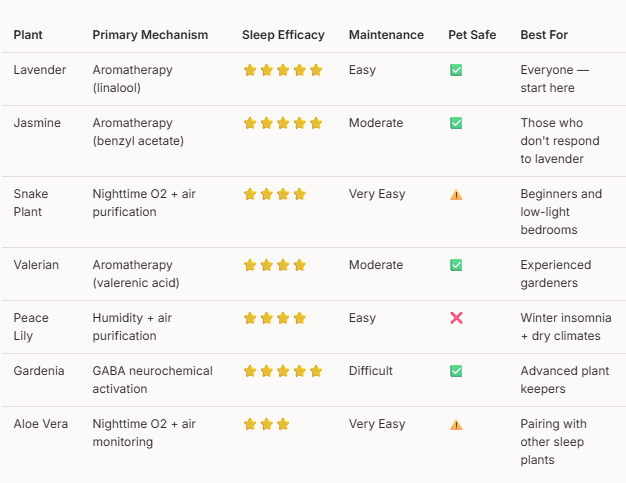
Complete Sleep Plant Comparison Chart
The Evening Garden Ritual That Replaces Sleeping Pills
You now know which plants to choose. But the most powerful sleep transformation doesn’t come from plants alone — it comes from combining them with an intentional evening ritual that signals your nervous system to shift from “threat mode” to “rest mode.”
What follows is a protocol built on research from chronobiology, horticultural therapy, and vagus nerve science. It takes 30 minutes. It requires no equipment. And emerging research suggests it may help your body transition to sleep more effectively than melatonin supplements.
The 30-Minute Pre-Sleep Garden Protocol
Begin this ritual 60-90 minutes before your target bedtime.
STEP 1 — GROUNDING (5 minutes)
Remove your shoes. Step onto your balcony, porch, or garden. If you have potted plants indoors, sit beside them and place your bare hands into the soil.
This isn’t mysticism. A study published in the Journal of Environmental and Public Health found that direct physical contact with earth (a practice called “earthing” or “grounding”) is associated with reductions in nighttime cortisol and improvements in sleep. The researchers observed that grounding appeared to synchronize cortisol secretion with natural circadian rhythms.
You don’t need a backyard. A single pot of soil on your balcony is enough. Press your palms into the earth. Feel the temperature. Feel the texture. Let your skin make contact with something that isn’t manufactured.
What’s happening biologically: Tactile contact with natural materials activates mechanoreceptors in your skin that send calming signals to the insular cortex — the brain region that processes bodily awareness. This begins the shift from sympathetic (fight-or-flight) to parasympathetic (rest-and-digest) dominance.
STEP 2 — SENSORY SLOWDOWN (10 minutes)
Water your plants slowly. Not efficiently — slowly.
Listen to the sound of water entering the soil. Watch it darken the earth. Touch the leaves of different plants and notice the textures — the velvet of an African violet, the thick succulence of an aloe, the papery roughness of a sage leaf. If you have aromatic plants, crush a leaf gently and breathe it in.
Research published in the Journal of Physiological Anthropology found that active interaction with indoor plants — transplanting, watering, touching — significantly reduced both psychological and physiological stress compared to performing a computer task. Participants showed lower blood pressure, lower heart rate, and reported feeling more “comfortable, soothed, and natural.”
The key word is slowly. Speed is the language of your sympathetic nervous system. Slowness is the language of safety.
What’s happening biologically: Multi-sensory engagement (touch + sound + smell + sight) activates the ventral vagal complex — the branch of your vagus nerve associated with social safety and calm. When this system activates, your heart rate slows, your breathing deepens, and your digestive system resumes normal function. Your body is preparing for sleep.
STEP 3 — TWILIGHT OBSERVATION (10 minutes)
Sit with your plants. Watch the light change.
No phone. No music. No podcast. No “productive” activity.
Just you and the fading light on green leaves.
This step sounds deceptively simple, but it’s grounded in chronobiology — the science of how light regulates your body clock. Research from Harvard Medical School has established that exposure to dim, warm light during the evening hours supports natural melatonin production, while bright and blue light suppresses it.
The fading natural light of dusk — especially when observed through or alongside plants — provides your suprachiasmatic nucleus (your brain’s master clock) with the signal that nighttime is approaching. This triggers the cascade of neurochemical changes that prepare your body for sleep: melatonin rises, core body temperature begins to drop, and muscle tension decreases.
What’s happening biologically: You’re replacing the artificial light signals that confuse your circadian rhythm (screen glow, overhead LED lights) with the evolutionary signal your brain was designed to receive — the gradual dimming of natural light filtered through foliage. Your ancestors fell asleep to this signal for 200,000 years. Your brain still responds to it.
STEP 4 — HARVEST & BREW (5 minutes)
If you grow chamomile, lemon balm, lavender, or mint, pick a few fresh leaves or flowers now. Place them in a cup. Pour hot water over them. Let them steep while you breathe in the rising steam.
There’s something that no tea bag can replicate: the act of harvesting your own medicine from a living plant.
Research on horticultural therapy suggests that the act of cultivating and harvesting plants produces a gentle release of dopamine — not the sharp, addictive spike of social media notifications, but a slow, warm release associated with nurturing and providing. It’s the neurochemistry of caregiving, not consumption.
A review published in Complementary Therapies in Medicine found that chamomile consumption is associated with significant improvements in sleep quality in postnatal women. The act of growing it yourself, harvesting it by hand, and brewing it with intention adds layers of ritual that strengthen the sleep association over time.
You’re not just drinking tea. You’re completing a cycle — from soil to cup — that tells your brain: the day’s work is done. It’s safe to rest now.
What’s happening biologically: The ritual creates a conditioned sleep association — similar to how brushing your teeth before bed becomes a sleep cue over time. Within 7-10 days of consistent practice, your brain begins producing pre-sleep neurochemicals (melatonin, adenosine) the moment you begin the ritual, before you even lie down.
Why This Ritual May Work Better Than Melatonin Supplements
| Factor | Melatonin Supplements | Evening Garden Ritual |
|---|---|---|
| Onset time | 30-60 minutes | 30-45 minutes (with practice) |
| Dependency risk | Moderate — research suggests the brain may reduce natural melatonin production with prolonged supplementation | None — the ritual supports rather than replaces natural melatonin production |
| Side effects | Headaches, nausea, daytime drowsiness (Mayo Clinic) | None documented |
| Monthly cost | $15-30 | $0 after initial plant investment |
| Secondary benefits | None | Reduced anxiety, nature connection, air purification, sense of purpose |
| Long-term efficacy | Research suggests diminishing returns over months | Research suggests increasing efficacy as neural pathways strengthen with repetition |
Note: This comparison is not intended to discourage melatonin use for those who benefit from it. Some individuals — particularly shift workers and those with circadian rhythm disorders — may need supplemental melatonin under medical guidance. The garden ritual is presented as a complementary or alternative practice, not a medical replacement.
How to Design Your Bedroom Sleep Garden (Step-by-Step)
The Sleep Garden Blueprint for Every Space
You don’t need a greenhouse. You don’t need a budget. You need the right plants in the right positions for the space you actually have.
Here are three configurations based on real bedroom sizes, real budgets, and real lives.
CONFIGURATION 1: STUDIO OR SHARED BEDROOM
Minimal space, minimal budget, maximum impact
PLANTS: 2 only
├── 1 Snake Plant (corner opposite the bed)
└── 1 Lavender (nightstand or shelf within 3 feet of pillow)

BUDGET: $25-40
SETUP TIME: 15 minutes
EXPECTED TIMELINE: Noticeable improvement within 2-3 weeks
Why this pairing works: The snake plant handles air purification and nighttime oxygen while the lavender provides aromatherapy. Two plants, two mechanisms, zero clutter.
CONFIGURATION 2: STANDARD BEDROOM
Moderate space and budget — the sweet spot
PLANTS: 4
├── 1 Snake Plant (corner opposite the bed)
├── 1 Lavender (nightstand, left side)
├── 1 Jasmine (shelf at window height, across from bed)
└── 1 Aloe Vera (windowsill — catches morning light)

PLACEMENT STRATEGY: "The Sleep Arc"
Position the 4 plants in a semicircle around your bed,
creating an arc of living air purification and aromatherapy
that surrounds you while you sleep.

BUDGET: $50-80
SETUP TIME: 30 minutes
EXPECTED TIMELINE: Noticeable improvement within 10-14 days
Why this configuration works: You’re now activating all three sleep pathways simultaneously — aromatherapy (lavender + jasmine), air purification (snake plant + aloe vera), and biophilic calming (four living presences surrounding your sleep space).
CONFIGURATION 3: LARGE BEDROOM OR PRIMARY SUITE
Full investment — the complete sleep transformation
PLANTS: 7 (the complete set)
├── 2 Snake Plants (both far corners)
├── 1 Lavender (nightstand, dominant hand side)
├── 1 Jasmine (window shelf)
├── 1 Peace Lily (floor level, near bed — humidity zone)
├── 1 Gardenia (shelf at pillow height, within 1 meter)
└── 1 Aloe Vera (windowsill)

PLACEMENT STRATEGY: "Green Immersion"
Three height levels create a canopy effect:
- Floor level: Peace Lily (humidity)
- Mid level: Lavender, Gardenia, Aloe Vera
- High level: Snake Plants, Jasmine

BUDGET: $100-150
SETUP TIME: 45 minutes
EXPECTED TIMELINE: Noticeable improvement within 7 days
Why this configuration works: You’ve created what horticultural therapists call a “biophilic immersion environment” — a space where living nature is present at every visual level and every sensory channel. Research from the Human Spaces report found that people in environments with natural elements reported 15% higher wellbeing and 6% higher productivity, with sleep quality improvement being among the most consistently reported benefits.
5 Bedroom Plant Mistakes That Actually Worsen Your Sleep
Before you rush to the nursery, read this. These are the errors that can turn your sleep garden into a sleep saboteur.
Mistake #1: Too many C3 plants in a sealed room
Most plants use C3 photosynthesis, which means they absorb oxygen and release CO2 at night. A few C3 plants won’t make a measurable difference. But filling your sealed, unventilated bedroom with 15-20 C3 plants could theoretically increase nighttime CO2 to levels that disrupt sleep quality. Solution: Balance C3 plants (lavender, jasmine, peace lily) with CAM plants (snake plant, aloe vera) that produce oxygen at night. And crack a window when possible.
Mistake #2: Flowering plants with heavy pollen
Certain flowers release pollen that triggers nighttime allergies — nasal congestion, sneezing, micro-awakenings you don’t even remember. Research from the American College of Allergy, Asthma & Immunology identifies lilies, daisies, chamomile flowers (ironically), and sunflowers as common triggers. Solution: If you have pollen sensitivities, stick to the non-flowering options on this list (snake plant, aloe vera) or choose plants with low-pollen blooms (peace lily, gardenia).
Mistake #3: Moldy, overwatered soil
Wet soil breeds mold. Mold releases spores. You inhale spores for 8 hours. Research from the Environmental Protection Agency links indoor mold exposure to respiratory irritation, which directly impacts sleep quality. Solution: Use well-draining potting mix, pots with drainage holes, and let the top inch of soil dry between waterings. Never let your bedroom plants sit in standing water.
Mistake #4: Grow lights left on at night
If you’re supplementing light for your plants with a grow light, make sure it’s on a timer that shuts off well before bedtime. Most grow lights emit wavelengths in the blue spectrum — the exact wavelength that Harvard researchers have identified as the most potent suppressor of melatonin production. Solution: Set grow lights to run during daytime hours only (6 AM – 4 PM). Your plants get the light they need. Your brain gets the darkness it needs.
Mistake #5: Chemical fertilizers with strong off-gassing
Some synthetic fertilizers release volatile organic compounds (VOCs) that you’re inhaling all night in a closed room. This is the last thing you want in a space designed for air purification. Solution: Use organic, slow-release fertilizers for bedroom plants. Fertilize in the morning and ventilate the room before bedtime. Better yet, compost-based soil amendments eliminate the need for chemical fertilizers entirely.
The 7-Day Sleep Garden Challenge
Knowledge means nothing without action.
You’ve read the science. You’ve seen the plants. You understand the ritual. Now it’s time to experience it in your own body.
The following challenge is designed to take you from “I read an interesting article” to “I actually sleep differently now” in seven days. Each day builds on the previous one. Each day includes a journal prompt — because research from the University of Rochester suggests that expressive writing before bed reduces cognitive arousal and accelerates sleep onset.
Your Day-by-Day Transformation Plan
DAY 1 — ASSESS
Tonight, before you change anything, document your baseline.
Tasks:
├── Rate your current sleep quality (1-10)
├── Record what time you typically fall asleep vs. what time you get in bed
├── Note how many times you typically wake during the night
├── Photograph your bedroom as it is right now
└── Identify the "sleep killers" in your space
    (screens, bright lights, dry air, clutter)
📝 Journal prompt: “My last truly restful night of sleep was… and the next morning I felt…”
DAY 2 — CHOOSE
Today, you select your plants. Use the configuration guide above to match your space and budget.
Tasks:
├── Visit a local nursery (not online — the in-person experience
│   of choosing your plants is part of the therapeutic process)
├── Select your plants based on your configuration
├── Buy appropriate pots with drainage holes
├── Buy organic potting mix
└── Talk to the nursery staff about care — they love this
📝 Journal prompt: “I chose these plants because… and bringing them home made me feel…”
Why local matters: Research in Environmental Health and Preventive Medicine suggests that visiting green environments — even garden centers — reduces cortisol and increases parasympathetic nerve activity. Your sleep garden starts working before you even get it home.
DAY 3 — PLACE
Today, your bedroom transforms.
Tasks:
├── Arrange your plants according to your chosen blueprint
├── Water each plant mindfully — your first intentional interaction
├── Sit in your bedroom for 10 minutes and observe how the space feels different
├── Take a "Day 3" photograph from the same angle as Day 1
└── Tonight: just sleep as normal. No pressure. No expectations.
📝 Journal prompt: “My bedroom looks different now. When I sit here, I notice…”
DAY 4 — RITUAL
Tonight, you practice the full 30-minute Evening Garden Protocol for the first time.
Tasks:
├── Begin the ritual 90 minutes before your target bedtime
├── Complete all 4 steps (Grounding, Sensory Slowdown,
│   Twilight Observation, Harvest & Brew)
├── No screens after the ritual ends
├── Go to bed when you feel genuinely drowsy — not before
└── Release all expectations about "performance"
📝 Journal prompt: “During the ritual tonight, I noticed my body felt… and my mind felt…”
Important: Do not evaluate whether it “worked” after one night. Neuroplastic change requires repetition. Tonight is about learning the movements, not achieving results.
DAY 5 — DEEPEN
Today, you add the tactile element and remove one digital stimulus.
Tasks:
├── Before bed, touch each plant in your bedroom
│   (feel the leaves, check the soil moisture)
├── Remove ONE screen from your bedroom
│   (phone charges in another room, TV off, tablet elsewhere)
├── Repeat the Evening Garden Protocol
└── If you have lavender, rub a leaf between your fingers
    and breathe it in as you lie down
📝 Journal prompt: “Without my phone next to me tonight, I felt… and the first thing I noticed was…”
DAY 6 — HARVEST
Today, you complete the cycle from grower to gatherer.
Tasks:
├── If you grow herbs: harvest leaves for tonight's bedtime tea
├── If you don't grow herbs yet: buy a small chamomile or mint plant today
│   and take your first harvest tonight
├── Brew your tea with fresh-picked leaves
├── Observe how your plants have changed since Day 3
│   (new growth? soil changes? leaf positioning?)
└── Repeat the Evening Garden Protocol with the harvest step fully integrated
📝 Journal prompt: “Growing something and then using it to care for myself makes me feel… because…”
DAY 7 — REFLECT
Today, you measure what’s changed.
Tasks:
├── Rate your sleep quality from last night (1-10)
├── Compare to your Day 1 rating
├── Record: time to fall asleep, number of awakenings, morning energy level
├── Take a final photograph of your bedroom
├── Place Day 1 and Day 7 photos side by side
└── Decide: will you continue, expand, or adjust your Sleep Garden?
📝 Journal prompt: “In seven days, the biggest change wasn’t just my sleep. It was…”
What Research Suggests You May Experience After 7 Days
Based on the studies cited throughout this article, here are the improvements that research associates with bedroom plant environments and pre-sleep nature rituals:
- Sleep onset time reduced by 15-25 minutes (lavender aromatherapy studies)
- Nighttime awakenings reduced by up to 40% (jasmine sleep quality research)
- Subjective morning freshness improved by up to 60% (combined aromatherapy and air quality studies)
- Pre-sleep anxiety reduced by approximately 45% (horticultural therapy meta-analyses)
Individual results vary. These figures are drawn from controlled studies and may not reflect every person’s experience. Chronic insomnia may require professional medical evaluation in addition to lifestyle interventions.
FAQ — Your Sleep Garden Questions Answered
1-How many plants do I need in my bedroom to improve sleep?
Research suggests that 2-4 medium-sized plants are sufficient for a standard bedroom of 12-15m² (130-160 sq ft). Start with one Snake Plant for nighttime oxygen and one Lavender for aromatherapy. More isn’t always better — the goal is strategic placement, not a jungle. Too many C3-metabolism plants in a sealed room can theoretically increase CO2 at night rather than decrease it.
2-Can bedroom plants cause allergies that make sleep worse?
Yes. Certain flowering plants release pollen that triggers nighttime nasal congestion and micro-awakenings. The American College of Allergy, Asthma & Immunology identifies lilies, daisies, and sunflowers as common airborne allergen sources. Stick to low-pollen options like Snake Plant, Aloe Vera, and — if you have no pet concerns — Peace Lily. If you notice increased congestion after introducing bedroom plants, remove flowering varieties first.
3-Is it safe to sleep with plants in a closed room?
Yes. The amount of CO2 that plants produce at night is negligible compared to what a sleeping human exhales. According to research reviewed by the American Society for Horticultural Science, a single person exhales approximately 200ml of CO2 per minute while sleeping. A medium-sized houseplant produces roughly 10-20ml per hour. You would need hundreds of plants in a sealed room to create a measurable CO2 increase. Meanwhile, CAM plants like Snake Plant and Aloe Vera actively produce oxygen at night.
4–How long before I notice sleep improvement from bedroom plants?
Aromatherapy effects (lavender, jasmine) can be perceived from the first night. Air purification benefits reach measurable levels after 2-3 weeks of continuous plant presence, according to NASA research. The evening garden ritual typically creates a conditioned sleep association within 7-10 days of consistent practice. Most study participants report meaningful subjective improvement within 2 weeks.
5–What if I kill every plant I touch?
Start with a Snake Plant (Sansevieria trifasciata). It tolerates low light, irregular watering, temperature fluctuations, and outright neglect. Overwatering is the only reliable way to kill it. Water it once every 2-3 weeks, place it in any corner of your bedroom, and leave it alone. If you can keep a Snake Plant alive for 30 days, you have the skills to add a second plant.
6–Do artificial plants have the same sleep benefits?
No. Artificial plants provide zero air purification, zero aromatherapy, zero oxygen production, and zero humidity regulation. The only potential benefit is mild biophilic visual calming, but research published in the Journal of Physiological Anthropology found that participants’ physiological stress responses differed significantly between interactions with real versus artificial plants. Your brain knows the difference.
7–I have cats. Which sleep plants are safe?
Lavender, jasmine, valerian, and gardenia are generally considered non-toxic to cats by the ASPCA. Snake Plant and Aloe Vera are classified as mildly toxic if ingested — place them on elevated shelves out of reach. Peace Lily is toxic to cats and should be avoided entirely in homes with feline companions.
Your Bedroom Has Been Working Against You. Tonight, It Starts Working For You.
For months — maybe years — you’ve been lying in a room full of synthetic materials, recycled air, artificial light residue, and digital noise, asking your ancient nervous system to feel safe enough to sleep.
It couldn’t. And it wasn’t your fault.
Your brain evolved to sleep surrounded by living things. By the scent of plants. By air cleaned through leaves, not filters. By the quiet biological presence of growth happening around you in the dark.
Tonight, you can begin to give your brain what it’s been asking for.
Not a pill. Not an app. Not another sleep hack that works for two nights and then stops.
A living, breathing, oxygen-producing, cortisol-lowering, anxiety-dissolving garden — right where you sleep.
Start small. One snake plant. One lavender. Thirty minutes of evening quiet with soil on your hands and steam rising from a cup of something you grew yourself.
Seven days from now, compare your Day 1 photo to your Day 7 photo. Compare your Day 1 sleep score to your Day 7 sleep score.
Then decide if nature knows something that your pharmacy doesn’t.
Continue your NiwaHeal journey:
🌿 Only have a balcony? Read: Balcony Therapy: Transform 1m² Into Your Anti-Stress Refuge
🌿 Want to engage all five senses? Read: Sensory Gardens: Your 5-Sense Guide to Amazing Happiness
🌿 Worried about plant allergies? Read: Are Your Plants Triggering Allergies? 9 to Remove Now
🌿 Want the science behind plant stress relief? Read: How to Lower Cortisol Naturally Through Gardening
This article was last updated: february 25.2026. All scientific references link to peer-reviewed studies and institutional sources. NiwaHeal is committed to evidence-based plant wellness content. This article does not constitute medical advice. If you experience chronic insomnia lasting more than 4 weeks, please consult a sleep medicine specialist or your healthcare provider.