Horticultural Therapy Made Simple: Grow Wellness, Heal Your Mind

Balcony Therapy: Transform 1m² Into Your Anti-Stress Refuge
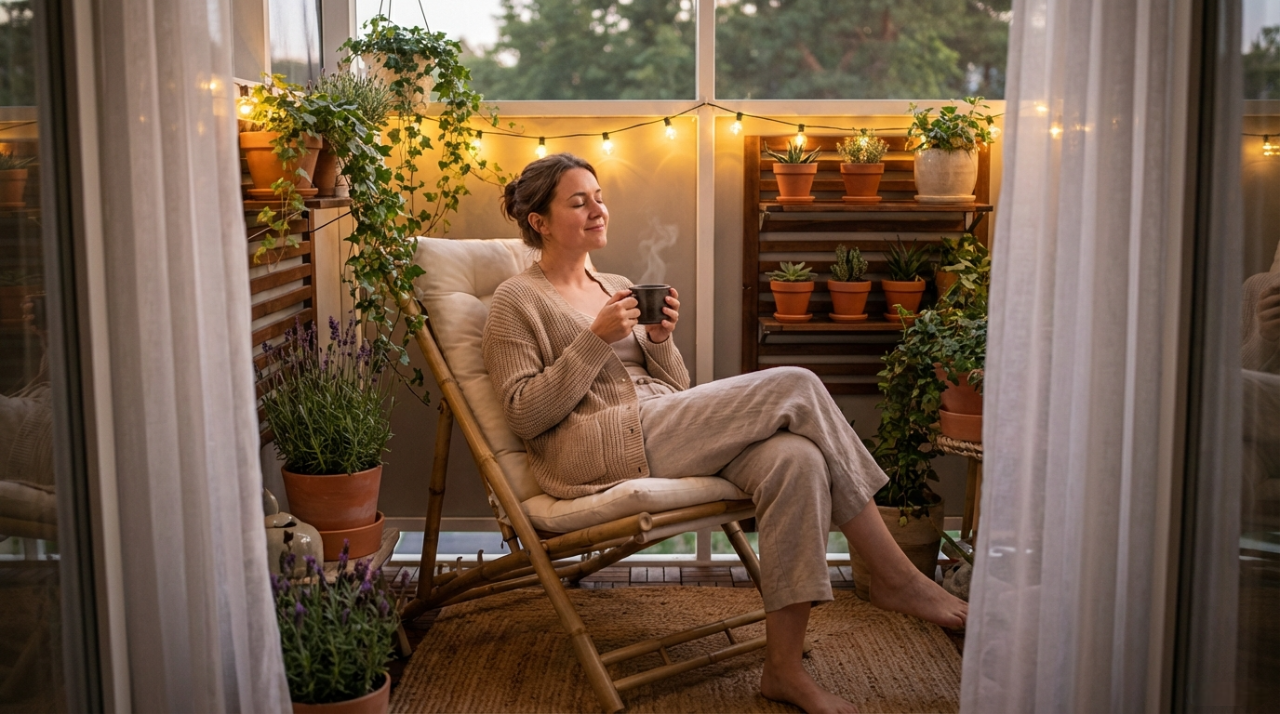
Table of Contents
Introduction
Balcony Therapy-You come home after a stressful day. Instead of collapsing on the couch, you step onto your balcony. What greets you isn’t concrete and chaos—it’s a small green refuge that immediately lowers your shoulders and slows your breathing.
Sound impossible with just 1 square meter? It’s not.
Over 80% of North Americans live in urban areas, and 60% lack access to a private garden. Yet research from the University of Michigan shows that just 20 minutes of nature contact significantly reduces cortisol levels—the stress hormone that keeps us wired and exhausted.
The surprising part? You don’t need a sprawling garden to experience these benefits. A thoughtfully designed balcony, even one measuring just 3 feet by 3 feet, can become your personal therapeutic space.
In this guide, you’ll discover three ready-to-copy plans for different light exposures, plant palettes that thrive in containers, a realistic budget breakdown, and a simple 10-minute daily routine that transforms your balcony into a mental health sanctuary.
Why Your Balcony Can Actually Become Therapeutic
The Science Behind “Balcony Therapy”
The concept of therapeutic gardening isn’t new age wishfulness—it’s backed by robust research. A landmark study published in the Journal of Environmental Psychology found that participants who spent 20-30 minutes gardening experienced a 15% reduction in cortisol compared to those who read indoors.
What’s remarkable is that size doesn’t determine impact. Research from Rutgers University demonstrates that the therapeutic benefits come from sensory engagement and routine, not square footage. Whether you’re tending a community garden plot or three pots on a fire escape, your nervous system responds similarly.
Sarah, a Toronto accountant managing anxiety, discovered this firsthand: “My balcony is barely 10 square feet, but those 15 minutes with my herbs each morning completely changed my relationship with stress. It’s like hitting a reset button before the day starts.”
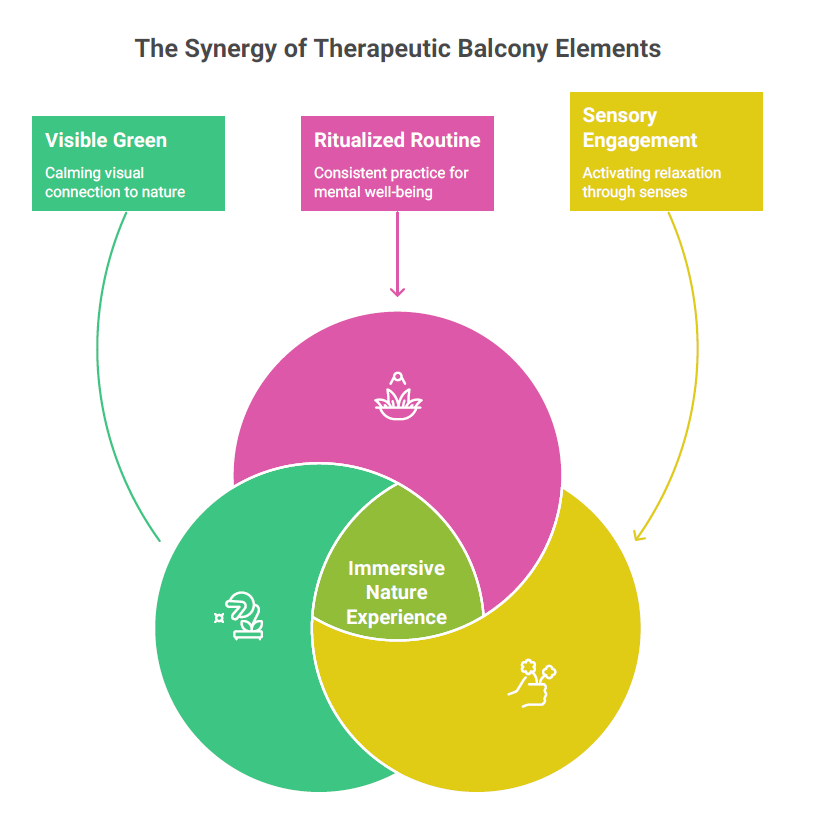
The 4 Pillars of a Calming Balcony
Creating therapeutic impact requires intentional design around these core elements:
1. Visible Green
Chlorophyll-rich plants with varied textures signal safety to your brain. Studies from the University of Washington show that even viewing green space through a window reduces heart rate and muscle tension.
2. Sensory Engagement
Touch, smell, and sound activate your parasympathetic nervous system—the “rest and digest” mode that counters stress. Running your fingers through lavender or hearing water trickling engages your senses in ways screens never can.
3. Ritualized Routine
Consistency matters more than duration. A Stanford Medicine study found that daily 10-minute nature routines produced better mental health outcomes than sporadic hour-long sessions.
4. Creative Control
Unlike most of our lives, a balcony garden is entirely yours to shape. This agency—choosing plants, arranging containers, watching your decisions bloom—provides psychological benefits that passive park visits don’t.
What Balconies Offer That Urban Parks Don’t
Public green spaces are valuable, but your balcony provides:
- 24/7 accessibility: No commute, no crowds, available at 6 AM or midnight
- Complete privacy: Process emotions without an audience
- Personal ownership: You shaped this; it reflects you
- Visible progress: Daily changes you witness and influence
This combination creates what environmental psychologists call “restorative environments”—spaces that actively replenish depleted mental resources.
Urban Constraints You Must Know Before Starting
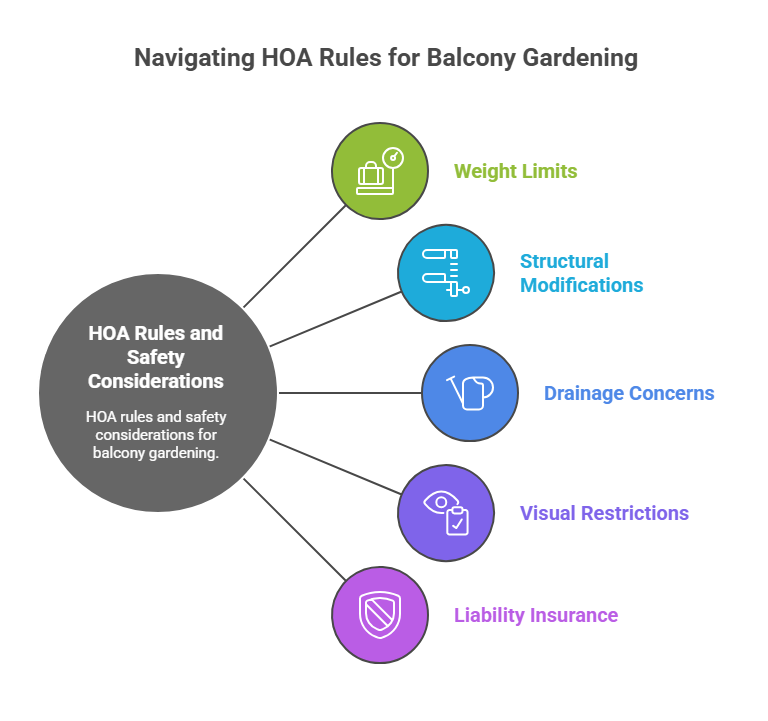
HOA Rules and Safety Considerations
Before purchasing a single plant, verify:
Weight limits: Most balconies safely support 50-100 lbs per square foot, but older buildings may restrict this. Check your lease or building management.
Structural modifications: Drilling into railings or walls typically requires approval. Clamp-on planters and freestanding containers avoid this issue entirely.
Drainage concerns: Water runoff onto lower balconies creates conflicts and potential liability. Always use saucers and ensure they’re emptied regularly.
Visual restrictions: Some buildings prohibit items visible from the street. If yours does, focus on low-profile containers and avoid tall structures.
Liability insurance: A falling pot can cause injury. Verify your renter’s or homeowner’s insurance covers balcony incidents.
Exposure and Microclimate Reality
Most people overestimate their balcony’s sun exposure. Here’s how to assess accurately:
Full sun: 6+ hours of direct, unobstructed light (rare in cities due to building shadows)
Partial shade: 3-6 hours of direct sun (most common for urban balconies)
Full shade: Less than 3 hours of direct sun (north-facing or between tall buildings)
Wind factor: Upper floors experience stronger winds that dry soil faster and can topple lightweight containers. Solutions include heavier pots, windbreaks, or stakes.
Heat radiation: Concrete and metal surfaces absorb heat, creating microclimates 10-15°F warmer than ground level. This affects watering needs significantly.
Use your phone to photograph your balcony every 2 hours on a sunny day. Count the hours of direct sun—not just bright light—to determine your true exposure.
Realistic Budget Breakdown
Initial setup: $150-$400 USD/CAD
Annual maintenance: $50-$100
Where beginners overspend:
- Too many plants too fast (3-5 is plenty for year one)
- Expensive decorative pots that don’t improve plant health
- Gadgets you won’t use (complicated irrigation for a 1m² space is overkill)
Where NOT to cut corners:
- Quality potting mix (cheap soil compacts and drains poorly)
- Adequate drainage holes (plants die from waterlogged roots)
- Appropriate plant selection (wrong plant = wasted money + discouragement)
3 Ready-to-Copy Plans for 1m² (Choose Your Light Level)
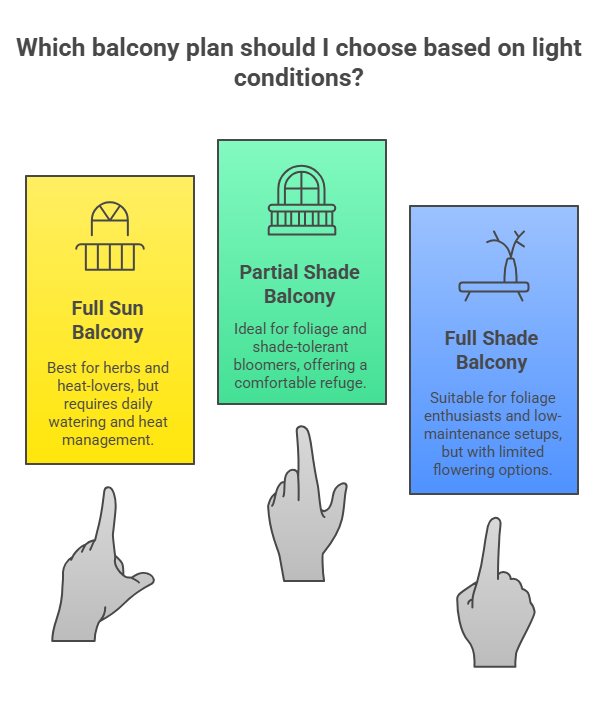
Plan A: Full Sun Balcony (South/West Facing)
Light conditions: 6+ hours direct sun
Challenge: Heat stress, rapid soil drying
Best for: Herbs, Mediterranean plants, heat-lovers
Container layout:
- 2 rectangular planters (16″×8″×8″) against railing
- 3 hanging baskets (6″ diameter) on hooks
- 1 small side table or stool for watering can
Plant palette (stress-reducing + resilient):
Structural base: Lavender (Lavandula angustifolia) — Research from Wesleyan University shows lavender scent reduces anxiety and improves sleep quality. Choose ‘Munstead’ or ‘Hidcote’ varieties for container hardiness.
Culinary aromatics: Rosemary (upright variety), Thyme (creeping), Basil (Genovese) — Touching these releases volatile oils that trigger calming responses. Plus, harvesting for meals adds purpose to your routine.
Visual color: Geraniums (Pelargonium) and Calendula — Both tolerate heat, require minimal care, and provide continuous blooms that signal vitality and growth.
Texture element: Blue Fescue (Festuca glauca) — This ornamental grass adds movement and sound when wind passes through, creating natural white noise.
Maintenance reality:
- Water daily in summer (check soil first)
- Fertilize every 2-3 weeks with diluted liquid feed
- Deadhead flowers weekly to encourage blooming
- Prune herbs regularly (they thrive on harvesting)
Common mistake: Assuming full sun means every plant will thrive. Even sun-lovers need consistent moisture. Pair bright light with diligent watering or invest in self-watering containers.
Plan B: Partial Shade Balcony (East/Partial West)
Light conditions: 3-6 hours of sun (often morning or late afternoon)
Challenge: Finding plants that bloom without full sun
Best for: Foliage-focused designs, shade-tolerant bloomers
Container layout:
- 1 wall-mounted planter (24″ horizontal) for vertical growing
- 4 varied-height pots (10″-14″) clustered in corner
- 1 trellis or small privacy screen (clamps to railing)
Plant palette (calming textures + low-effort):
Foliage foundation: Dwarf Hostas (‘Blue Mouse Ears’ or ‘Mighty Mouse’) and Heuchera (Coral Bells) — Both thrive in dappled light and provide season-long interest without demanding deadheading.
Shade-tolerant flowers: Impatiens (New Guinea varieties) and Tuberous Begonias — These deliver color in partial shade where sun-lovers fail.
Edible aromatics: Mint (MUST be in its own sealed pot—it’s invasive), Parsley, Chives — All tolerate less sun and make daily interaction purposeful.
Vertical element: English Ivy (Hedera helix) or Boston Fern (in hanging basket) — Creates lushness and visual privacy without taking floor space.
Maintenance reality:
- Water 3-4 times weekly (check moisture 2″ down)
- Less fertilizer needed than full-sun plants
- Trim leggy growth to maintain shape
- Rotate pots monthly so all sides get light
Bonus advantage: Partial shade means you can actually sit comfortably on your balcony during hot afternoons, making it a usable refuge rather than just something you look at through glass.
Plan C: Full Shade Balcony (North-Facing or Between Buildings)
Light conditions: Less than 3 hours direct sun
Challenge: Limited flowering options, slower growth
Best for: Foliage enthusiasts, meditation spaces, low-maintenance setups
Container layout:
- 1 three-tier plant stand (maximizes vertical space)
- Decorative cache-pots (since drainage matters less with low water needs)
- Light-colored surfaces or mirrors to reflect available light
Plant palette (thrives in low light):
Reliable foliage: Pothos (Epipremnum aureum), Philodendron (heartleaf variety), Cast Iron Plant (Aspidistra elatior) — These handle neglect better than almost any other plants and improve indoor air quality if you bring them inside during winter.
Texture and movement: Mixed Ferns (Autumn, Boston, Maidenhair) — Their delicate fronds create a calming visual rhythm. Ferns evolved in forest understories and thrive without direct sun.
Seasonal surprise: Spring bulbs (Muscari, Crocuses, Miniature Daffodils) — Plant these in fall for early spring color when shade gardens are often dull.
Edible option: Leafy Greens (arugula, lettuce, spinach) — Grow these in spring and fall when temperatures are cool. They actually prefer shade in warmer climates.
Maintenance reality:
- Water only 2x weekly (shade = less evaporation)
- Overwatering is the bigger risk here than underwatering
- Clean leaves monthly (dust blocks limited light)
- Rotate plants periodically so growth stays balanced
Design tip: Shade balconies benefit enormously from adding reflective elements—light-colored gravel as mulch, white or metallic containers, or a small decorative mirror. These amplify scarce light and create the illusion of more space.
Quick Reference Comparison
| Exposure | Watering | Difficulty | Setup Cost | Star Plants |
|---|---|---|---|---|
| Full sun | Daily in summer | Medium | $250 | Lavender, rosemary, geraniums |
| Partial shade | 3-4x weekly | Easy | $200 | Hostas, mint, impatiens |
| Full shade | 2x weekly | Very easy | $180 | Ferns, pothos, leafy greens |
Plant Palettes by North American Climate Zone
Climate matters more than you might think. A lavender that thrives in Vancouver will struggle in Montreal winters. Here’s how to adapt your plant choices:
Zones 3-5 (Canada, Northern USA: Edmonton, Winnipeg, Minneapolis, Fargo)
Winter challenge: Extreme cold kills most container plants unless protected
Hardy perennials (can winter outdoors with protection):
- Thyme, oregano, chives (herb family survivors)
- Coral bells (Heuchera) — Evergreen foliage
- Sedum and hens-and-chicks (succulents rated to Zone 3)
- Dwarf conifers (Picea glauca ‘Conica’)
Annual stars (one season, then compost):
- Petunias, marigolds, nasturtiums
- Impatiens, snapdragons, pansies
Winter strategy: Either bring tender plants indoors (rosemary, lavender) or treat them as annuals. Insulating pots with burlap and moving them against the building wall can extend survival, but temperatures below 0°F will kill most roots.
Planting timeline: Late May to early June (last frost typically mid-May)
Zones 6-7 (Toronto, Montreal, Boston, Chicago, New York)
Sweet spot: Long enough growing season for most plants, but real winters require planning
Perennials worth the investment:
- Hardy lavender (Lavandula angustifolia ‘Munstead’)
- Dwarf coneflowers (Echinacea)
- Wintergreen (Gaultheria procumbens)
- Russian sage (Perovskia atriplicifolia)
Season extenders:
- Frost cloth (lightweight fabric) protects plants down to 28°F
- Bubble wrap around pots insulates roots
- South-facing walls create microclimates 5-10°F warmer
Winter options: Ornamental kale, pansies, miniature evergreens create visual interest when most plants are dormant. Add string lights for ambiance—your balcony doesn’t have to be “dead” for six months.
Planting timeline: Early May outdoor, start seeds indoors mid-March
Zones 8-10 (Vancouver, Seattle, Portland, San Francisco)
Advantage: Year-round growing with mild winters
Year-round possibilities:
- Most herbs survive winters (rosemary becomes a small shrub)
- Citrus trees in large containers (Improved Meyer Lemon)
- Succulents and cacti outdoors permanently
- Tropical-looking plants (banana, bird of paradise in protected spots)
Winter color:
- Primroses, pansies, violas bloom through winter
- Ornamental cabbage and kale peak in cold weather
- Winter-blooming heather and jasmine
Challenge to watch: Rain, not cold. Ensure excellent drainage—more container plants die from waterlogged roots than drought in Pacific Northwest climates. Elevate pots on “feet” and drill extra drainage holes if needed.
Planting timeline: Nearly continuous; spring and fall are ideal, but avoid planting during summer heat waves
Regional resource: Cornell University’s Home Gardening portal provides zone-specific plant recommendations and extension office contacts for local expertise.
Creating Privacy and Ambiance (Without Construction)
Blocking Sight Lines and Urban Noise
Visual privacy solutions:
Bamboo screens: Roll-up or fixed panels lean against railings without drilling. Avoid running bamboo in pots—it’s invasive. Use clumping varieties or stick with non-living screens.
Climbing plants on tension trellises: Annual vines (scarlet runner beans, morning glories) grow fast and die back in winter, so no long-term commitment. Perennial climbers (clematis, climbing hydrangea) take years to fill in but create permanent screening.
Tall container arrangements: Cluster tall plants (ornamental grasses, upright evergreens) strategically to break sight lines without fully enclosing the space.
Acoustic masking:
Small fountain: Solar-powered fountains (no outlets needed) create gentle water sounds that mask traffic noise. Keep volume subtle—loud burbling gets annoying fast.
Wind chimes: Choose low-tone chimes (bamboo, larger metal tubes) over high-pitched tinkling. Place where they catch breeze but won’t drive neighbors crazy.
Rustling plants: Ornamental grasses like Mexican feather grass or bamboo create natural white noise when wind moves through them.
Critical consideration: Don’t block your neighbor’s light or views—it creates conflicts and can violate building codes. Privacy solutions should be considerate, not fortress-like.
Lighting for Evening Calm
String lights (LED solar): Create warm ambiance without electrical work. Drape along railings or overhead (if you can attach safely). Warm white (2700K) is more relaxing than cool white.
Lanterns with candles: Real flame creates irreplaceable ambiance, but requires vigilance. Never leave unattended and check building fire codes. Battery-operated “flickering” LED candles are safer alternatives.
Avoid: Bright spotlights, harsh downlights, or anything that creates glare. Your balcony should feel like a refuge, not an interrogation room.
Timing tip: Turn lights on 30 minutes before sunset. This gradual transition from daylight to evening is psychologically soothing—abrupt darkness triggers mild stress responses.
Minimal Essential Furniture
One comfortable seat: This is non-negotiable. A folding wooden chair, weatherproof pouf, or floor cushion (store indoors when wet). You need to actually sit here, not just look at it through glass.
One small table: For morning coffee, a book, or setting down your watering can. Foldable or nesting tables work if space is tight.
Nothing else: More furniture = less plant space and maintenance hassle. Keep it simple.
Sensory Finishing Touches
Textures: An outdoor rug (even 2’×3′) defines the space and feels good underfoot. Natural materials like jute or cotton are more calming than synthetic.
Scents: Avoid artificial fragrances. Let your plants provide natural aromatics. In winter, place a small dish of cedar chips or dried lavender on your table—subtle and seasonal.
Visual warmth: Terracotta pots, wooden containers, and warm-toned fabrics (rust, olive, cream) feel more calming than cold metallics or bright plastics.
The goal is sensory richness without clutter—every element should have a purpose and bring you peace.
The 10-Minute Daily Anti-Stress Routine
Consistency beats intensity every time when it comes to therapeutic impact. Here’s how to structure your time for maximum mental health benefit:
Morning: Energize (5-10 minutes)
Step 1: Open your balcony door and take 3 deep breaths before doing anything else. Research from Harvard Medical School shows that conscious breathing immediately activates your parasympathetic nervous system.
Step 2: Do a gentle inspection. Notice new growth, changes in color, any stress signals from plants. This observation practice trains your brain to notice subtlety—a skill that transfers to emotional awareness.
Step 3: Water if needed (stick your finger 2 inches into soil—if dry, water until it drains). Watering becomes a moving meditation when done mindfully.
Step 4: Touch your plants. Run your fingers through herb foliage, brush fern fronds, deadhead spent flowers. Physical contact with plants has measurable stress-reduction effects according to studies from Kansas State University.
Step 5: Set a simple intention. Not a big goal—just “Today I will notice three things that went well” or “I’ll drink water when I feel stressed.” Your balcony ritual primes your brain for intentionality.
Evening: Decompress (10-15 minutes)
Step 1: No screens for 15 minutes before your balcony time. This is crucial—breaking phone habit creates space for actual restoration.
Step 2: Sit without agenda. You don’t have to “do” anything. Watch clouds, listen to evening sounds, observe how light changes. This is where the magic happens—unstructured outdoor time resets your nervous system.
Step 3: Deadheading or light grooming. Remove faded flowers, clip yellowing leaves, pinch back leggy growth. These repetitive tasks occupy your hands while your mind processes the day. It’s therapeutic fidgeting.
Step 4: Three-line journal. Keep a small notebook on your balcony table. Write three things you noticed today—not accomplishments, just observations. “The basil smells stronger in humidity.” “Fern has two new fronds.” This practice builds present-moment awareness.
Step 5: Gratitude micro-practice. Before going inside, mentally note one small thing you’re grateful for. Research from UC Berkeley shows that brief daily gratitude practices significantly improve wellbeing—more than long weekly sessions.
Weekend: Project Time (30-60 minutes)
Use weekends for deeper engagement:
- Repotting or propagation: Dividing plants, taking cuttings, refreshing soil
- Deep cleaning: Washing pots, pruning, treating any pest issues
- Creative rearrangement: Moving plants around, trying new combinations
- Progress documentation: Take photos from the same angle monthly to see growth
This extends your balcony practice into something anticipatory—you look forward to weekend projects, which gives your week structure.
Seasonal Activity Guide
| Season | Focus | Key Activities |
|---|---|---|
| Spring | Preparation & Planting | Clean pots, refresh soil, sow seeds, introduce new plants |
| Summer | Maintenance & Harvest | Daily watering, fertilizing, deadheading, harvesting herbs |
| Fall | Transition & Protection | Plant spring bulbs, protect tender plants, compost annuals |
| Winter | Rest & Planning | Move to indoor plants, plan next year, enjoy evergreens |
Easy Watering and Water Conservation (Especially in Heat Waves)
Watering kills more balcony plants than any other factor—both too much and too little. Here’s how to get it right:
Watering Systems for Balconies
Manual with intelligence: An adjustable-flow watering can with a long spout (18-24″) gives you control. Add a moisture meter ($10) to eliminate guesswork—most plants want soil that’s damp, not soaking wet.
Semi-automatic DIY: Invert water bottles with slow-release spikes (available at garden centers or DIY with nail holes in caps). These provide 2-3 days of gradual watering—useful for weekend absences.
Full automation: Drip irrigation kits with timers ($80-150) connect to outdoor faucets or use reservoir buckets. Worth it if you travel frequently or your balcony gets intense sun. Systems from DIG or Raindrip are balcony-friendly.
Rainwater collection: Small collection barrels or even 5-gallon buckets can capture significant water where allowed. Check local regulations—some municipalities encourage it, others prohibit it. Even if you can’t store it, watering immediately after rain means less tap water used.
5 Water-Saving Strategies
1. Mulching: Even 1-2 inches of organic mulch (bark chips, cocoa hulls, straw) reduces evaporation by 30-40%. It also regulates soil temperature and suppresses weeds.
2. Water-retaining crystals: Polymer crystals mixed into potting soil absorb water when abundant and release it slowly when soil dries. Use sparingly—too much creates soggy conditions. Follow package directions carefully.
3. Container choices: Terra cotta is beautiful but porous—it breathes, which means faster drying. Plastic, resin, or glazed ceramic containers hold moisture longer. In hot climates, this matters significantly.
4. Group plants: Clustering pots creates a humid microclimate. Plants transpire moisture, which benefits neighbors. This also makes watering more efficient—you’re not crossing the balcony repeatedly.
5. Timing matters: Water early morning or evening—never mid-day in sun. Midday watering wastes water to evaporation and can shock plants with cold water hitting hot leaves.
Diagnosing Water Problems
| Issue | Symptoms | Solution |
|---|---|---|
| Underwatering | Wilted leaves, dry cracked soil, stunted growth, crispy edges | Water deeply until draining, add mulch, check daily in heat |
| Overwatering | Yellow leaves, moldy soil surface, root rot smell, fungus gnats | Improve drainage, water less often, repot if severe root damage |
Pro tip: Lift your pots when freshly watered to feel the weight. Check again when soil is dry. This weight difference teaches you when plants actually need water without relying on schedules or guesswork.
Special Winter: Maintaining Connection (Without Living Plants)
Just because growing season ends doesn’t mean your balcony refuge disappears. Here’s how to keep the therapeutic connection alive:
Option 1: Extend the Season
Hardy winter plants:
- Ornamental kale and cabbage (beautiful and cold-tolerant to 20°F)
- Dwarf conifers (provide evergreen structure)
- Winter-blooming heather (blooms in January-March)
- Pansies and violas (surprisingly cold-hardy with protection)
Protection methods:
- Frost cloth or burlap wraps for tender perennials
- Bubble wrap around pot exteriors (insulates roots)
- Move pots against building walls (creates warmer microclimate)
Reality check: Below 0°F, most container plants struggle regardless of protection. Know your limits and don’t feel defeated when plants don’t survive extreme cold.
Option 2: Dormant But Inviting Balcony
Winter decor that maintains connection:
- Decorative branches (curly willow, birch, red dogwood twigs)
- Pinecones, dried seed heads, preserved leaves
- Evergreen boughs in containers (free after Christmas tree recycling)
- Warm white string lights for ambiance
Bird feeding station: A simple feeder attracts chickadees, finches, and other winter birds. Watching wildlife provides indirect nature connection when plants are dormant. Ensure feeders don’t create mess on lower balconies.
Winter ritual: 5 minutes each morning with hot beverage, observing weather, watching birds, noticing how light changes through the season. Your balcony remains a mindfulness anchor even without active gardening.
Option 3: Indoor Continuity
Bring herbs indoors: Rosemary, thyme, and lavender can winter on sunny windowsills under grow lights. This maintains your touching-and-harvesting routine.
Microgreens on windowsills: Fast-growing sprouts (sunflower, pea shoots, wheatgrass) provide 10-day harvest cycles. The process satisfies your gardening urge during dormancy.
Planning becomes the activity: Seed catalogs, sketching next year’s layout, ordering supplies. Anticipation is part of the therapeutic cycle—winter planning makes spring planting more intentional.
Detailed Budget and Ready Shopping List
Financial transparency matters. Here’s exactly what you’ll spend:
Economy Setup ($150-200)
Containers:
- Recycle options first: 5-gallon buckets (drill holes), old crates, yogurt containers (free-$5)
- Basic plastic pots: 6-pack assorted sizes ($30)
Soil and amendments:
- 30-liter bag basic potting mix ($15)
- Perlite for drainage improvement ($8)
Plants:
- 6 annual plants from local nursery ($30)
- 3 herb starts ($15)
- 1 perennial on sale ($10)
Tools:
- Hand trowel ($8)
- Watering can (1-gallon) ($12)
- Garden gloves ($7)
Extras:
- Basic liquid fertilizer ($10)
- Plant labels ($5)
Total: ~$155
Pros: Extremely affordable entry point
Cons: Plants need replacing annually, basic containers less attractive
Standard Setup ($250-350)
Containers:
- 3 decorative resin planters with saucers ($80)
- 2 hanging baskets with chains ($30)
Soil and amendments:
- 50-liter premium potting mix with fertilizer ($35)
- Perlite and vermiculite mix ($15)
- Mulch (small bag) ($8)
Plants:
- 7 annual/perennial mix ($60)
- 5 herbs (variety) ($30)
- 2 feature plants (lavender, ornamental grass) ($30)
Tools:
- Quality hand tool set (trowel, pruner, cultivator) ($40)
- Adjustable watering can with rose ($20)
- Moisture meter ($12)
- Garden gloves (2 pairs) ($15)
Extras:
- Organic fertilizer (granular + liquid) ($25)
- Mulch ($15)
- Solar string lights ($30)
- Plant labels and stakes ($10)
Total: ~$305
Pros: Better quality everything, mixed annuals/perennials, includes ambiance
Cons: Still requires yearly plant replacement
Premium Comfort Setup ($400-600)
Containers:
- 4 glazed ceramic or quality terracotta ($150)
- Self-watering planters (2) ($60)
- Vertical wall planter ($40)
Soil and amendments:
- Organic specialty potting mix 100L ($60)
- Mycorrhizal inoculant (beneficial fungi) ($15)
- Premium compost ($12)
- Decorative mulch (cocoa hulls) ($20)
Plants:
- 10 perennials (long-term investment) ($120)
- 5 annuals for color ($35)
- 3 specimen plants (dwarf fruit tree, ornamental) ($60)
Tools:
- Professional hand tool set, ergonomic ($70)
- Haws watering can (copper or galvanized) ($45)
- Digital moisture/light/pH meter ($25)
- Quality knee pad ($18)
- Garden gloves (multiple pairs) ($20)
Automation:
- Drip irrigation kit with timer ($100)
Furniture:
- Folding teak chair or quality outdoor seating ($80)
- Small side table ($35)
Extras:
- Outdoor rug small ($40)
- Solar fountain ($45)
- Complete fertilizer set (organic) ($30)
Total: ~$610
Pros: Heirloom-quality tools, perennial investment, full automation, comfortable space
Cons: Significant upfront cost (though amortized over years)
Annual Maintenance ($50-100)
Regardless of initial setup, expect ongoing costs:
- Soil refresh (top 2-3 inches) annually: $20
- Seasonal fertilizer: $15
- New annual plants: $25-50
- Container replacement (breakage): $10-20
- Miscellaneous (ties, labels, amendments): $15
Where to Buy (North America)
Local nurseries (always check first):
- Plants are acclimated to your specific climate
- Staff provide personalized advice
- Support local businesses
- Often host plant swaps (free plants!)
Big-box chains (Home Depot, Lowe’s, Rona, Canadian Tire):
- Competitive pricing on tools and containers
- Seasonal sales (spring, late summer clearance)
- Consistent availability
Online sources:
- Etsy: Unique handmade containers, rare plant seeds
- Amazon: Tools, irrigation systems, grow lights (read reviews carefully)
- Specialty mail-order nurseries (High Country Gardens, Proven Winners): Quality guaranteed, but shipping stress on plants
Community resources:
- Plant swaps at libraries, community gardens
- Facebook groups (local gardening communities often give away divisions)
- Craigslist/Kijiji free sections (pots, soil, sometimes plants)
Money-saving hack: Most perennials can be divided every 2-3 years. One $15 hosta becomes three plants. Propagate herbs from cuttings—one rosemary plant can become six with minimal effort.
Adapting for Special Situations
Real life isn’t always simple. Here’s how to make Balcony Healing work anyway:
Shared Balconies (Roommates, Partners)
Establish clear zones: Even 0.5m² personal space prevents conflicts. Use containers to define boundaries visually.
Maintenance agreement: Who waters when you’re away? Who buys supplies? Document expectations before resentment builds.
Shared vs. personal plants: Consider a few communal statement plants plus individual containers each person controls completely.
Aesthetic compromise: If your styles clash, agree on a cohesive color palette (all terra cotta pots, for example) with personal plant choices.
Communication rule: No plant gets removed without discussion. Vetoes should be rare and require valid reasons (allergies, safety).
With Children (Safety + Engagement)
Non-negotiable safety rules:
Zero toxic plants: Avoid dieffenbachia, lily of the valley, oleander, foxglove, castor bean, and dumb cane. The ASPCA provides a comprehensive toxic plant database at aspca.org/pet-care/animal-poison-control.
Secure all containers: Heavy pots at ground level, lightweight ones away from edges. A falling ceramic pot from even one story can cause serious injury.
Tool safety: Sharp pruners and pointed stakes must be stored out of reach. Give children their own child-safe tools (plastic trowels, soft watering cans).
Supervision under age 6: Young children lack impulse control around water, soil, and heights. Never leave them unsupervised on balconies.
Creating their ownership:
Give children one container that’s entirely theirs. Let them choose (within safe options): cherry tomatoes, snap peas, sunflowers, or nasturtiums—all grow fast enough to maintain interest.
Kid-friendly plants that teach:
- Sunflowers (dramatic height growth)
- Snap peas (edible AND climbable)
- Strawberries (immediate reward)
- Sensitive plant (Mimosa pudica—leaves fold when touched)
Age-appropriate tasks:
- Ages 3-5: Watering with supervision, touching leaves, counting flowers
- Ages 6-9: Deadheading, harvesting, measuring growth, journaling observations
- Ages 10+: Full responsibility for their container, propagation, planning
Research from the Royal Horticultural Society shows that children who garden develop better concentration, patience, and emotional regulation. Your balcony becomes a teaching tool as much as a refuge.
With Pets (Cats, Dogs, Birds)
Safe plant list for cats and dogs:
- Herbs: Basil, rosemary, thyme, cat grass (Dactylis glomerata)
- Flowers: Roses, zinnias, sunflowers, snapdragons
- Foliage: Spider plants, Boston ferns, African violets
- Palms: Areca, bamboo, parlor palm
Absolutely toxic (incomplete list—always verify):
- Lilies (even pollen is deadly to cats)
- Azaleas and rhododendrons
- Tulips and daffodils (bulbs especially)
- Sago palm
- Aloe vera (ironically toxic despite medicinal use for humans)
Cross-reference everything with ASPCA’s Animal Poison Control Center database before purchasing. Symptoms of plant poisoning include drooling, vomiting, lethargy, and difficulty breathing—seek veterinary care immediately if suspected.
Pet-proofing strategies:
Physical barriers: Chicken wire or decorative fencing around delicate plants prevents digging and chewing.
Elevated containers: Hanging baskets and tall plant stands keep toxic plants out of reach (cats can jump 5-6 feet, so “high” means very high).
Distraction plants: Provide cat grass or catnip in dedicated containers—cats often chew plants out of boredom or nutritional needs.
Training boundaries: Positive reinforcement when pets ignore plants, gentle redirection when they investigate. Never punish—they don’t understand plant value.
Bonus: Many people find that their pets enjoy balcony time as much as they do. A cat lounging in sunlight near your herbs or a dog sitting beside you while you water creates shared peaceful moments.
Mobility Limitations
Ergonomic solutions:
Raised containers: Plant stands, tables, or custom-built elevated beds bring plants to waist or chest height, eliminating bending and kneeling.
Vertical gardens: Wall-mounted planters, hanging systems, or tiered shelving maximize accessibility without floor-level gardening.
Long-handled tools: Extendable trowels, grabbers, and watering wands reduce reaching and strain. Companies like Radius Garden specialize in ergonomic designs.
Seated gardening: Rolling garden stools or sturdy chairs with armrests provide stable seating. All activities can be performed seated if containers are positioned correctly.
Automated watering: Drip systems with timers become necessity rather than luxury. Self-watering containers reduce bending frequency.
Layout principles:
- Keep paths clear and wide (walker/wheelchair accessible)
- Arrange most-accessed plants closest to door
- Use lightweight containers (resin over ceramic)
- Consider everything within arm’s reach from seated position
Adaptive tools worth investing in:
- Haws indoor watering can (long spout, perfect balance)
- Trigger-grip pruners (require less hand strength)
- Foam grips for standard tools (easier to hold)
- Garden kneeler with handles (doubles as seat and support)
Occupational therapy research from the American Horticultural Therapy Association demonstrates that adapted gardening improves hand-eye coordination, fine motor skills, and provides purposeful physical activity regardless of mobility level.
Top 5 Beginner Mistakes (I’ve Made Them All)
Mistake #1: Buying Too Many Plants Too Fast
Why it happens: Nurseries are intoxicating. Everything looks healthy and manageable. Then you get home and realize you’ve created a jungle that demands two hours of daily care.
The cost: Overwhelm leads to neglect. Plants die. You feel guilty and defeated.
The fix: Start with 3-5 plants maximum in year one. Master those. Add gradually. Quality beats quantity—three thriving plants provide more therapeutic value than fifteen struggling ones.
Mistake #2: Ignoring Your Actual Light Exposure
Why it happens: You desperately want sun-loving tomatoes, so you convince yourself your north-facing balcony gets “enough” light.
The cost: Plants etiolate (grow tall and spindly searching for light), don’t flower, and eventually die. You blame yourself rather than physics.
The fix: Accept your light reality. Photograph your balcony hourly one sunny day. Count direct sun hours honestly. Choose plants that match what you have, not what you wish you had.
Mistake #3: Cheaping Out on Potting Mix
Why it happens: Soil looks like soil. A $5 bag seems identical to a $25 bag.
The cost: Cheap mixes compact quickly, drain poorly, and lack nutrients. Plants suffocate, roots rot, growth stagnates. You water more (making it worse) and blame your “black thumb.”
The fix: Buy quality potting mix specifically labeled “container mix” or “potting soil” (never garden soil, which is too dense). Look for ingredients like peat moss or coir, perlite, and vermiculite. It should feel light and fluffy, not heavy and clumpy.
Mistake #4: Forgetting Drainage
Why it happens: Decorative pots rarely have holes. You assume you’ll “just be careful” with watering.
The cost: No drainage = inevitable overwatering. Roots sit in water, rot develops, plants die mysteriously.
The fix: Drill holes in decorative pots (use a masonry bit for ceramic) OR use them as cache-pots with a draining plastic liner inside. Always use saucers, but empty them 30 minutes after watering.
Mistake #5: Giving Up After First Failure
Why it happens: You killed a lavender. Clearly you’re not “a plant person.”
The cost: You abandon the whole project, missing out on years of potential benefits.
The fix: Every gardener kills plants—it’s data collection, not failure. That lavender taught you something (maybe your balcony has less sun than you thought, or you overwatered). Try a different plant. Adjust. Keep going.
Mindset shift: Gardening is a skill learned through experimentation. Even experienced gardeners lose plants to weather, pests, or mysterious causes. The goal isn’t perfection—it’s connection.
Tracking Progress and Staying Motivated Long-Term
Initial enthusiasm is easy. Maintaining engagement through setbacks, busy periods, and winter dormancy requires structure.
Visual Documentation
Monthly photo ritual: Same angle, same time of day, first day of each month. After six months, flip through the sequence—you’ll be astonished by growth you didn’t notice day-to-day.
Use your phone’s camera timer to include yourself occasionally. These become powerful reminders: “This is when I was most stressed at work” or “This was right after I recovered from illness.” Your balcony’s evolution parallels your life.
Time-lapse option: Some security cameras or old smartphones can be repurposed as time-lapse devices. Watching a season compressed into 60 seconds is mesmerizing and reinforces your impact.
Simple Mood Tracking
Keep a small waterproof notebook on your balcony (or use a notes app). After your morning or evening session, rate three things on a 1-10 scale:
- Stress level (1=calm, 10=overwhelmed)
- Energy level (1=exhausted, 10=energized)
- Mood (1=down, 10=great)
After a month, look for patterns. Most people notice measurable improvements in all three metrics. This data is powerful when doubt creeps in (“Is this actually helping?”).
Research from the Journal of Health Psychology shows that people who track wellness metrics alongside behavioral changes are 40% more likely to maintain those behaviors long-term.
Measuring Indirect Benefits
Your balcony’s therapeutic impact often shows up in unexpected ways:
- Sleep quality (falling asleep faster, fewer night wakings)
- Reduced reliance on other stress coping (less doomscrolling, fewer stress snacks)
- Increased presence (noticing details in other parts of life)
- Relationship improvements (patience, emotional availability)
Notice these ripples. They’re evidence your practice is working.
When to Level Up
After 6 months: If you’ve maintained your routine and plants are thriving, add complexity. Try propagation (rooting cuttings), expand by 0.5m², or join a community garden as a natural extension.
After 1 year: Consider mentoring someone else who wants to start. Teaching solidifies your knowledge and creates accountability—you’re now “the balcony garden person.”
Never: Compare your balcony to Instagram fantasies. Most social media gardens are styled for photos, not realistic daily maintenance. Your balcony is for living, not performing.
Frequently Asked Questions
Q: How much does a therapeutic 1m² balcony actually cost?
A: Initial setup ranges from $150 (budget-conscious) to $400 (comfortable), with $50-100 annually afterward for soil refresh and plant replacements. The investment pays back through reduced stress, improved sleep, and daily moments of calm. Compare this to gym memberships ($50/month), therapy co-pays ($30-100/session), or stress-related retail therapy.
Q: My balcony gets zero direct sun. Is this even possible?
A: Yes. Focus on shade-loving foliage plants (ferns, pothos, hostas) and leafy greens in cool seasons. Add reflective surfaces (mirrors, white containers) to maximize available light. Shade gardens are often lower maintenance than sun gardens—think lush forest floor rather than meadow.
Q: I travel frequently for work. Will everything die?
A: Not with preparation. Automated drip irrigation with timers ($100-150) solves 90% of absence issues. For shorter trips (3-4 days), self-watering containers or inverted bottle systems work. Alternatively, trade plant-sitting with a neighbor—you water theirs when they’re gone, they water yours.
Q: What if I have cats or dogs?
A: Many plants are pet-safe: basil, rosemary, spider plants, Boston ferns, and cat grass. Always cross-reference with ASPCA’s toxic plant database before purchasing. Elevate toxic plants beyond reach (though if you have jumping cats, it’s safer to avoid them entirely). Provide pet-friendly alternatives like cat grass to redirect chewing behavior.
Q: How much time does this realistically take per week?
A: Summer peak: 10 minutes daily (70 minutes/week) plus 30-60 minutes weekend maintenance = 100-130 minutes weekly. Off-season: 2-3 hours monthly. The time investment shrinks as you develop routine and choose low-maintenance plants. Even if you miss days, the impact accumulates—consistency matters more than perfection.
Q: My balcony is concrete and depressing. Where do I even start?
A: Day 1: Add an outdoor rug or door mat (instant warmth). Day 2: Place 3 pots of different heights with green foliage. Day 3: Add one aromatic plant (mint or basil). The transformation is immediate. Your brain responds to visible green and natural textures—you don’t need a finished design to feel the effect.
Q: Can I do this in winter?
A: Growing options narrow in harsh winters, but your balcony can remain a refuge. Hardy plants (ornamental kale, dwarf conifers) withstand cold. Add bird feeders, string lights, and evergreen boughs. Your morning ritual becomes observation—weather patterns, bird activity, changing light—which provides mindfulness anchor points even without active gardening.
Q: What if my partner/roommate thinks this is silly?
A: Frame it as a health practice, not a hobby. Share research on nature exposure and stress reduction. Invite them to sit with you once—experience often converts skeptics faster than arguments. If they remain unsupportive, establish boundaries: this is your 1m² wellness practice that doesn’t impact their space.
Q: I killed three plants already. Should I just give up?
A: Absolutely not. Every experienced gardener has killed plants—it’s how you learn your specific microclimate. Those three plants taught you valuable lessons (probably about watering, light, or drainage). Analyze what went wrong, adjust your approach, and try again. The goal isn’t perfection; it’s connection. Even struggling plants provide that.
Conclusion: Your Balcony Refuge Starts Now
A 1m² balcony may seem insignificant against your apartment’s total square footage. But measured in therapeutic impact, those 10-11 square feet can become the most valuable space in your home.
The research is clear: regular nature contact reduces cortisol, improves sleep quality, enhances emotional regulation, and provides daily restoration from urban stress. You don’t need a sprawling estate to access these benefits—you need intention, consistency, and a few well-chosen plants.
The real cost isn’t money (though $150-400 is modest for years of daily use). The cost is committing to those 10 minutes each morning or evening. To stepping outside even when it’s cold. To watering even when you’re tired. To sitting still even when your phone buzzes.
That commitment is how transformation happens—not through dramatic redesigns, but through small daily rituals that compound over time.
Your next step is simple: Choose your plan (A for sun, B for partial shade, C for full shade), download the shopping list below, and order your first three plants this week. Not next month when you’ve researched every option. Not next spring when weather is perfect. This week.
Your balcony refuge doesn’t require perfect conditions—it requires a start.
Ready to Transform Your 1m²?
Start small. Stay consistent. Notice the changes—both in your plants and in yourself.
Your Balcony Healing practice begins the moment you step outside and decide that these few square feet matter. That your wellbeing matters. That even in the middle of a concrete city, you can create a refuge that heals.
The plants are waiting. Your morning coffee tastes better surrounded by green. And your future self—the one who feels calmer, sleeps better, and handles stress with more grace is thanking you for starting today.
Scientific References
- Stigsdotter, U.K., et al. (2011). “Health promoting outdoor environments.” Journal of Environmental Psychology, 31(4), 288-297.
- Park, B.J., et al. (2010). “The physiological effects of Shinrin-yoku: Evidence from field experiments in 24 forests across Japan.” Environmental Health and Preventive Medicine, 15(1), 18-26.
- Van Den Berg, A.E., & Custers, M.H. (2011). “Gardening promotes neuroendocrine and affective restoration from stress.” Journal of Health Psychology, 16(1), 3-11.
- Gonzalez, M.T., et al. (2010). “Therapeutic horticulture in clinical depression: A prospective study.” Research and Theory for Nursing Practice, 24(4), 312-328.
- Soga, M., et al. (2017). “Gardening is beneficial for health: A meta-analysis.” Preventive Medicine Reports, 5, 92-99.
- ASPCA Animal Poison Control Center. (2024). “Toxic and Non-Toxic Plant List.” Retrieved from aspca.org/pet-care/animal-poison-control
- Berman, M.G., et al. (2008). “The cognitive benefits of interacting with nature.” Psychological Science, 19(12), 1207-1212.
- Kaplan, R., & Kaplan, S. (1989). The Experience of Nature: A Psychological Perspective. Cambridge University Press.