Horticultural Therapy Made Simple: Grow Wellness, Heal Your Mind

Gentle Pilates Routine: Slow Down, Breathe, Regain Energy
Table of Contents
Gentle Pilates Routine: Slow Down, Breathe, Regain Energy
Have you ever slept all night and still woken up tense, tired, and strangely disconnected from your body? The answer isn’t always a harder workout, a stricter diet, or another expensive “biohack.” Sometimes a gentle Pilates routine, built around controlled movement, breath, and recovery, is a more sustainable place to start.
In this article, you’ll find what research does (and doesn’t) say about Pilates, how to match your practice to your energy level, and a 12-minute routine you can do at home, with scientific sources you can check yourself.
Before you begin: This article is for educational purposes only and does not replace advice from a healthcare professional. Pilates can support general well-being, but it does not diagnose or treat any condition. If you have pain, an injury, pregnancy complications, persistent fatigue, or psychological distress, talk to a doctor, physiotherapist, or certified instructor.
Why “more intensity” isn’t always the answer
We’re often told to push harder, never skip a workout, and optimize everything. But health doesn’t rest on effort alone. It also depends on sleep, recovery, stress management, and a routine that genuinely fits your life.
That’s where Pilates fits in. It’s not “just stretching,” and it’s not a miracle cure for fatigue. It’s an exercise method that emphasizes controlled movement, core stability, alignment, mobility, and breathing. For someone who sits for long hours, has a demanding schedule, or feels intimidated by high-intensity fitness, it’s a realistic way in.
Where Pilates fits within official guidelines
According to the World Health Organization, adults should aim for 150 to 300 minutes of moderate-intensity aerobic activity per week (or 75 to 150 minutes of vigorous activity), plus muscle-strengthening exercises involving the major muscle groups on at least two days a week. These recommendations are detailed in the WHO 2020 guidelines on physical activity and sedentary behaviour, which also stress that some activity is better than none.
Pilates can contribute to that plan, especially for strength, mobility, and balance, but it doesn’t need to be your only activity. Walking, cycling, swimming, or dancing combine well with it.
What Pilates can offer
A well-guided practice can help you build, consistently:
- functional strength for everyday movement (posture, lifting, carrying);
- endurance in the deep core muscles;
- gentle joint mobility;
- balance and coordination;
- a movement habit that’s easy to stick with;
- a calm transition between stressful parts of your day;
- greater awareness of your breathing, tension patterns, and limits.
The goal isn’t a “perfect” body. It’s a repeatable practice that helps you feel more at home in your own.
Pilates and mental well-being: what the research says
Studies exist, but they need to be read with nuance.
- A 2018 meta-analysis on Pilates and mental health pooled eight studies (390 participants) and looked at depressive and anxiety symptoms, as well as mental fatigue and perceived energy. Its authors urge caution, however: few controlled trials, small samples, and comparison groups of variable quality.
- A 2023 systematic review gathered 18 randomized controlled trials (827 women) to study the effect of Pilates on depressive symptoms, with anxiety as a secondary outcome.
- A more recent review (32 trials, 1,264 participants) concludes that Pilates is a feasible option with demonstrated benefits for quality of life and self-esteem, while the evidence for depression and anxiety remains limited or non-significant.
In practice: Pilates can be a pleasant complement to a well-being routine, but the evidence is still mixed. It doesn’t replace professional care or prescribed treatment.
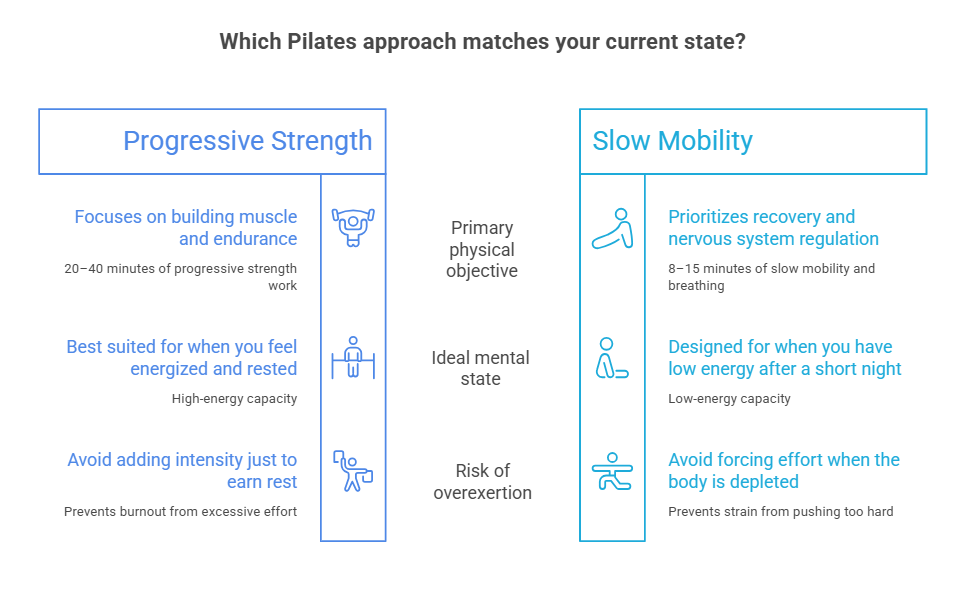
Adjust the dose to your day, not your self-worth
Your energy shifts with your sleep, mental load, life stage, and how you feel today. Listening to those signals is part of the practice. This is adaptive consistency, not “doing less because you failed.”
| How you feel | A useful Pilates option | What to avoid |
|---|---|---|
| Energized and rested | 20–40 minutes of progressive strength work | Adding intensity just to “earn” rest |
| Stiff from sitting | Gentle spine, hip, and shoulder mobility | Ranges of motion that cause pain |
| Low energy after a short night | 8–15 minutes of slow mobility and breathing | Forcing effort |
| Mentally overloaded | A simple, repetitive routine with long pauses | Complex sequences that add stress |
| Pain, dizziness, or unusual symptoms | Stop and seek qualified advice | Pushing through warning signs |
The most effective routine is often the one you can repeat.
Pilates, daily rhythm, and energy
Your body clock (circadian rhythm) helps regulate, among other things, your sleep-wake cycle. According to the U.S. National Institute of General Medical Sciences (NIGMS), light from electronic devices at night can throw this clock off, and the brain uses sunlight, among other signals, to keep time (NIGMS). A scientific review also notes that light affects circadian rhythms, sleep, and mood, beyond its role in vision.
Pilates doesn’t “reset” your body clock on its own. It can, however, support habits that make a stable rhythm more likely.
A simple thread through your day
- Morning: 5 to 15 minutes of gentle movement, ideally after some time in daylight.
- Midday: a short mobility break to interrupt long periods of sitting.
- Evening: a slow, low-intensity session centered on breathing, not a demanding workout right before bed.
The best time to practice isn’t the theoretically “ideal” hour. It’s the one you can sustain without hurting your sleep or adding pressure.
A pressure-free rhythm
- Get outside into daylight in the morning when you can.
- Take a 10-minute movement break before the afternoon slump.
- Choose your session based on your current energy, not guilt.
- Cut back on stimulating screens in the evening.
- Keep bedtime and wake time reasonably consistent.
It’s not a miracle protocol, just simple habits that reinforce each other.
Your 12-minute gentle Pilates routine
This routine is designed for beginners and low-energy days. You’ll need a mat, carpet, or folded blanket. Move slowly, stay within a comfortable range, and stop if you feel pain, dizziness, numbness, unusual shortness of breath, or any symptom that worries you.
1. Arrive and breathe: 1 minute
Lie on your back with knees bent and feet on the floor (or sit upright in a chair).
- Place your hands on your lower ribs.
- Inhale comfortably and feel your rib cage widen.
- Exhale slowly, without forcing.
- Soften your jaw, shoulders, and hands.
Purpose: shift from “doing” to noticing your body.
2. Shoulder circles and neck release: 1 minute
Stay seated or lying down.
- Slowly roll your shoulders up, back, and down, 5 times, then reverse.
- Gently turn your head right and left, without pulling.
Purpose: release common tension spots (screens, phone).
3. Cat-cow: 2 minutes
On hands and knees, hands under shoulders, knees under hips.
- Exhale as you gently round your back.
- Inhale as you lengthen your spine and slightly open your chest.
- Repeat 8 to 10 times. Make the movement smaller if your wrists, knees, or back feel sensitive.
Purpose: mobilize the spine by coordinating breath and movement.
4. Pelvic tilts: 2 minutes
Back on your back, knees bent.
- On an exhale, gently tilt your pelvis so your low back moves closer to the mat.
- On an inhale, return to a neutral, comfortable position.
- 8 to 10 repetitions, small and controlled.
Purpose: build awareness of the pelvis, lower back, and abdominal wall.
5. Gentle bridge: 2 minutes
Still on your back.
- Press softly through your feet and lift your hips only as high as feels comfortable.
- Pause for one breath, then lower with control.
- 6 to 8 slow repetitions.
Purpose: strengthen hips and legs while practicing control.
6. Alternating knee lifts: 2 minutes
On your back, knees bent.
- On an exhale, lift one foot a few centimeters off the floor.
- Place it down with control, then alternate.
- 6 to 8 repetitions per side, keeping your pelvis as steady as possible.
Purpose: introduce gentle abdominal and hip control without aggressive core work.
7. Rest and body scan: 2 minutes
Lie or sit comfortably and ask yourself:
- Where do I feel more space?
- Has my breathing changed since I started?
- What do I need tomorrow: rest, water, light, connection, support?
This final pause is part of the practice: learning to respond to your body rather than override it.
How often should you practice?
Start smaller than you think you need to.
| Week | Pilates plan | Supporting habit |
|---|---|---|
| Week 1 | Two 10–12 minute sessions | A 5-minute walk each day |
| Week 2 | Three 10–15 minute sessions | Gentle mobility after long periods of sitting |
| Week 3 | Two short sessions plus one 20-minute class | Simply note your sleep and energy, without judgment |
| Week 4 | Aim for three sessions a week if it feels sustainable | Add walking, cycling, or an aerobic activity you enjoy |
Safety and individual needs
Pilates can be adapted, but the adaptation matters. Get personalized advice before starting or changing your practice if you have:
- new, severe, or unexplained pain;
- recent surgery or injury;
- pelvic floor symptoms;
- osteoporosis, or a cardiovascular, neurological, or chronic condition;
- pregnancy or postpartum recovery needs;
- persistent fatigue, dizziness, fainting, chest pain, or breathlessness;
- a history of disordered eating or compulsive exercise;
- depression, anxiety, or trauma that makes body-focused activity difficult.
For pregnancy and the postpartum period, the American College of Obstetricians and Gynecologists states that, in the absence of complications or contraindications, physical activity is safe and desirable, while emphasizing the importance of personalized medical advice.
Building a well-rounded routine
Pilates works best when it isn’t asked to do everything. No single session can make up for chronic sleep loss, under-eating, medical symptoms, isolation, or overwhelming stress. For a balanced approach, pair your practice with:
- walking or regular aerobic activity;
- progressive muscle strengthening;
- regular meals that suit your needs;
- daylight and a steady sleep schedule;
- moments that do you good (nature, music, writing, creativity, time with others);
- medical follow-up for any persistent symptom.
Conclusion: move with your body, not against it
A gentle Pilates routine is a practical way to slow down, breathe more intentionally, and build strength without an all-or-nothing mindset. Its real value isn’t a quick transformation, but a lasting relationship with movement.
Start with 10 to 12 minutes. Notice how you feel before and after. Adjust to your energy and health, then build gradually around sleep, nourishment, strength, walking, daylight, and recovery.
Your next step: pick a moment this week for your first 12-minute session, and keep going with [link to your “Biohacking for Women” article] to build on your energy.
Frequently asked questions
How long does it take to feel the effects of a gentle Pilates routine? It varies from person to person. Rather than chasing quick results, notice how you feel before and after each session.
Can you do Pilates every day? Short, gentle sessions can be repeated often, but listen to your body and keep rest days if you feel tired or sore.
Is Pilates enough as your only physical activity? It can be a great foundation, but the WHO also recommends regular aerobic activity and muscle strengthening (see above). Pilates pairs well with both.
Sources
- World Health Organization (Europe), Physical activity (fact sheet): https://www.who.int/europe/news-room/fact-sheets/item/physical-activity
- Bull FC et al., World Health Organization 2020 guidelines on physical activity and sedentary behaviour, Br J Sports Med (PubMed): https://pubmed.ncbi.nlm.nih.gov/33239350/
- The effects of Pilates on mental health outcomes: A meta-analysis of controlled trials, Complementary Therapies in Medicine (2018): https://www.sciencedirect.com/science/article/abs/pii/S0965229917306118
- Ju M et al., The impact of Pilates exercise for depression symptoms in female patients: A systematic review and meta-analysis, Medicine (2023): https://pmc.ncbi.nlm.nih.gov/articles/PMC10578749/
- Effects of Pilates-Based Exercise on Mental Health, Psychological Well-Being, and Quality of Life: A Systematic Review and Meta-Analysis (PMC): https://pmc.ncbi.nlm.nih.gov/articles/PMC13210596/
- NIGMS (National Institutes of Health), Circadian Rhythms: https://www.nigms.nih.gov/education/fact-sheets/Pages/circadian-rhythms
- NIGMS, Why Am I So Tired?: https://nigms.nih.gov/biobeat/2023/07/why-am-i-so-tired
- Blume C et al., Effects of light on human circadian rhythms, sleep and mood, Somnologie (2019): https://pmc.ncbi.nlm.nih.gov/articles/PMC6751071/
- ACOG, Committee Opinion No. 804: Physical Activity and Exercise During Pregnancy and the Postpartum Period: https://www.acog.org/clinical/clinical-guidance/committee-opinion/articles/2020/04/physical-activity-and-exercise-during-pregnancy-and-the-postpartum-period
- 9-8-8: Suicide Crisis Helpline (Canada): https://988.ca/get-help/what-to-expect