Horticultural Therapy Made Simple: Grow Wellness, Heal Your Mind

Therapeutic Horticulture: 12-Week Science-Backed Habit Guide
Table of Contents
Why Growing Things May Help You Feel Better
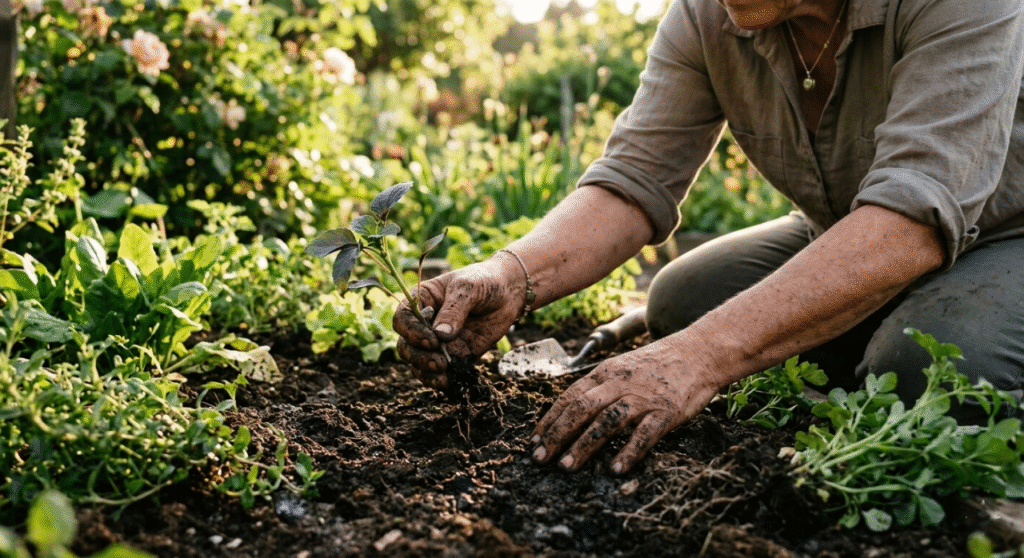
Imagine starting your morning not by reaching for your phone, but by stepping outside to check on a seedling you planted last week — watching it stretch toward the light, just as you’re trying to do.
That small, quiet moment is what therapeutic horticulture is built on. And the research community is increasingly paying attention to why it seems to work.
Therapeutic horticulture — the intentional use of plant-based activities to support physical, mental, and emotional well-being — is practiced in hospitals, senior care homes, burnout recovery clinics, and mental health programs across North America. It’s recognized by organizations like the American Horticultural Therapy Association (AHTA) as a legitimate wellness modality.
This 12-week guide is designed for everyone: whether you’re navigating stress or anxiety, recovering from burnout, living with a chronic condition, looking for gentle senior-friendly movement, rebuilding your relationship with food, or simply wanting a meaningful daily habit that actually sticks.
No backyard required. No gardening experience necessary. Just a willingness to slow down and grow — inside and out.
What the Research Suggests: The Science of Gardening and Well-Being
Before we plant a single seed, it’s worth understanding the scientific frameworks that researchers use to explain why nature-based activities may support our health. These are not absolute guarantees — individual results vary — but the emerging evidence is compelling.
The Biophilia Hypothesis
Biologist E.O. Wilson proposed that humans have an innate, evolutionary affinity for other living systems — a concept he called “biophilia.” The idea is that, having evolved in natural environments over millennia, we may experience psychological discomfort when cut off from nature. While this remains a theoretical framework, it has generated significant research into how contact with plants and green spaces may influence mood and stress perception.
Attention Restoration Theory (ART)
Environmental psychologists Rachel and Stephen Kaplan developed Attention Restoration Theory (ART) to explain how natural environments might help restore our capacity for focused attention. Their research suggests that “directed attention” — the mental effort required for tasks like emails, planning, and decision-making — depletes over time. Nature, they proposed, engages what they called “soft fascination”: an effortless, restorative form of attention that may allow our minds to recover. Gardening is considered one of the most accessible activators of this effect, though more research is still needed to fully understand the mechanisms.
Soil, Microbes, and Mood: A Preliminary Finding
Some researchers have studied a soil bacterium called Mycobacterium vaccae and its potential effects on the nervous system. Preliminary animal studies suggested it might influence serotonin pathways — the same pathways targeted by some antidepressant medications. Human research in this area is still early-stage, and no clinical conclusions should be drawn. That said, the hypothesis that skin contact with soil could play a role in mood regulation is an active and intriguing area of scientific inquiry.
Nature, Stress, and Cortisol: What Studies Show
Several studies have examined the relationship between time spent in natural environments and cortisol levels (a key biological marker of stress). Some research suggests that spending even 20 minutes in a green environment may be associated with reduced cortisol for some individuals. Results vary significantly across populations and study designs, and gardening alone should not be considered a treatment for clinical stress disorders. However, as a complementary wellness practice, the early findings are encouraging.
Why 12 Weeks? The Science of Habit Formation
You may have heard that it takes 21 days to form a habit. That figure is widely cited but not well-supported by research. A study published in the European Journal of Social Psychology (Lally et al., 2010) found that, on average, new behaviors took between 59 and 66 days to become automatic — with a wide range of 18 to 254 days depending on the person and the behavior.
Our 12-week program spans approximately 84 days — deliberately structured to carry most participants past the automaticity threshold. The goal is that by Week 12, tending your garden feels less like a task and more like a natural part of your day.

Who May Benefit From Therapeutic Horticulture?
Based on existing research and the clinical experience of AHTA-affiliated practitioners, therapeutic horticulture has been explored as a supportive practice for:
- People experiencing stress, anxiety, or low mood — as a complement to professional care
- Individuals recovering from burnout — seeking gentle structure, purpose, and grounding
- Seniors — looking for cognitive engagement, light physical activity, and social connection
- Those managing chronic illness or pain — to support quality of life and reduce isolation
- People rebuilding their relationship with food — through a non-clinical connection to fresh produce
- Individuals in PTSD or trauma recovery programs — where it is used under professional supervision
- Children with attention or behavioral challenges — in structured, therapist-led settings
- Healthy individuals — seeking meaningful habits for stress prevention and lifestyle improvement
If you are healthy and reading this for yourself: you are also the most likely person to share this with someone who needs it. That matters too.
Before You Begin: A Simple Self-Assessment
Inspired by structured programs like the NATURE intervention model used in some research settings, we recommend a brief personal check-in before Week 1. This is not a clinical tool — it’s simply a way to start where you actually are, rather than where you think you should be.
Take 10 minutes to write your answers:
- What is my current stress level, roughly, on a scale of 1 to 10?
- How many minutes per day do I currently spend outdoors or near living plants?
- What would I like to feel differently at the end of 12 weeks?
- What is my living situation — apartment, house, access to a balcony or garden?
- Are there any physical limitations I should keep in mind when choosing activities?
Keep these answers somewhere safe. You’ll revisit them at Week 12, and the comparison is often meaningful.
Your 12-Week Therapeutic Horticulture Program
The program is divided into three four-week phases, each building on the last. Each week includes a theme, four practical activities, and a research-informed tip. Adapt freely to your environment and energy level.
- Phase 1 — Root (Weeks 1–4): Sensory grounding and slowing down
- Phase 2 — Grow (Weeks 5–8): Nutrition, movement, routine, and rest
- Phase 3 — Bloom (Weeks 9–12): Mindfulness, community, and sustainability
Phase 1: Root — Sensory Grounding (Weeks 1–4)
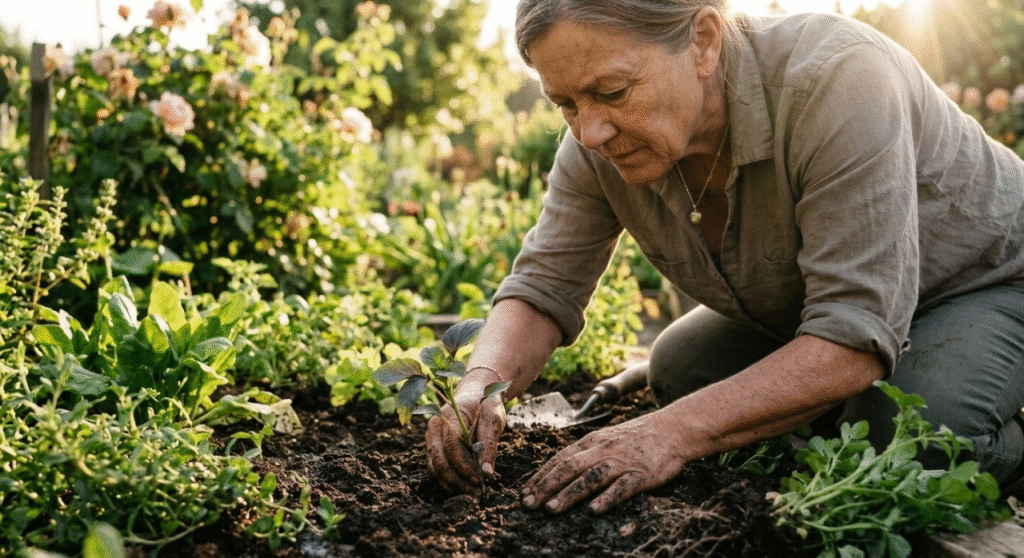
The goal of Phase 1 is to slow your nervous system and begin building a new relationship with presence. Before habits can form, we need to feel safe enough — and interested enough — to change.
Week 1: Meet the Soil
Your only task this week: make contact with the earth. Spend at least 10 minutes each day touching a plant, soil, or natural material. There are no goals, no outcomes to measure. Just presence and sensory awareness.
- Visit a garden center or local park and simply observe for 15 minutes
- Buy one small plant or seed packet that genuinely interests you
- Repot a plant or fill a small container with potting soil — use your hands
- Sit with your palms in soil for 5 minutes and breathe slowly

Week 2: Breathe and Observe — Finding Soft Fascination
This week we practice mindful observation: the art of truly noticing a living thing. Drawing on Attention Restoration Theory, researchers suggest this kind of effortless attention may give our overworked minds a chance to recover from the demands of daily cognitive load.
- Choose one plant to observe each day — its color, texture, smell, how it changes
- Keep a simple plant journal with 3 observations each day (no expertise needed)
- Practice 5 minutes of slow breathing near your plant each morning
- Photograph your plant at the same time each day and notice small changes

Week 3: Plant Something From Scratch
Planting a seed is a simple act with a surprisingly strong emotional dimension. In horticultural therapy practice, starting from seed is often noted as one of the most meaningful activities — a tangible, living expression of hope and new beginnings.
- Choose easy-to-grow seeds: radishes, sunflowers, basil, mint, or parsley — widely available across North America
- Set up your space: a pot, potting mix, drainage, a light source
- Plant your seeds following simple instructions and create a watering routine
- Consider naming your plant — small attachments support consistent care

Week 4: Invite Your Body Into the Garden
We now gently introduce movement. Gardening activities provide structured physical activity without the psychological resistance that formal exercise sometimes triggers — particularly for those recovering from illness, burnout, or long periods of inactivity.
- Spend 20 minutes on light tasks: watering, weeding, rearranging pots
- Practice 5 minutes of gentle stretching before and after your session
- Try 10 minutes of barefoot walking on grass or soil — sometimes called ‘grounding’
- Note how your body feels before and after each session in your journal

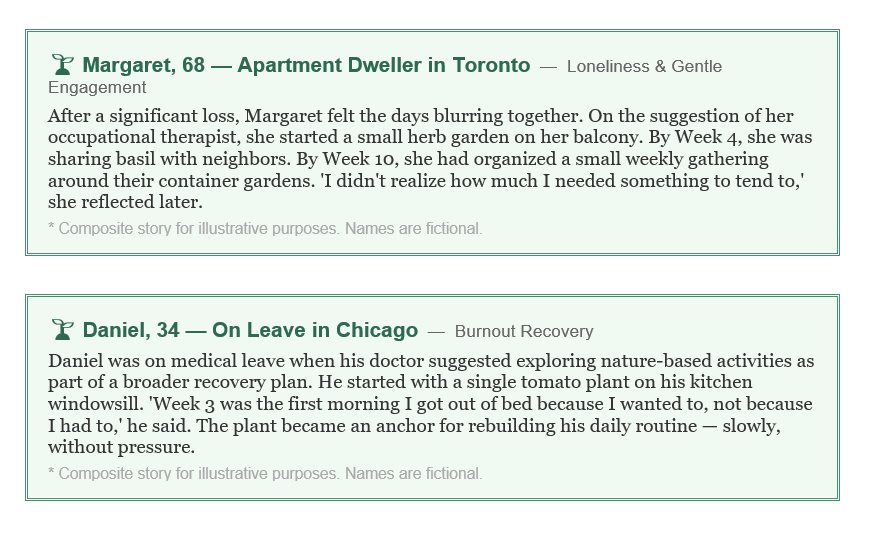
Illustrative Stories: What This Can Look Like
Phase 2: Grow — Healthy Habits in Practice (Weeks 5–8)
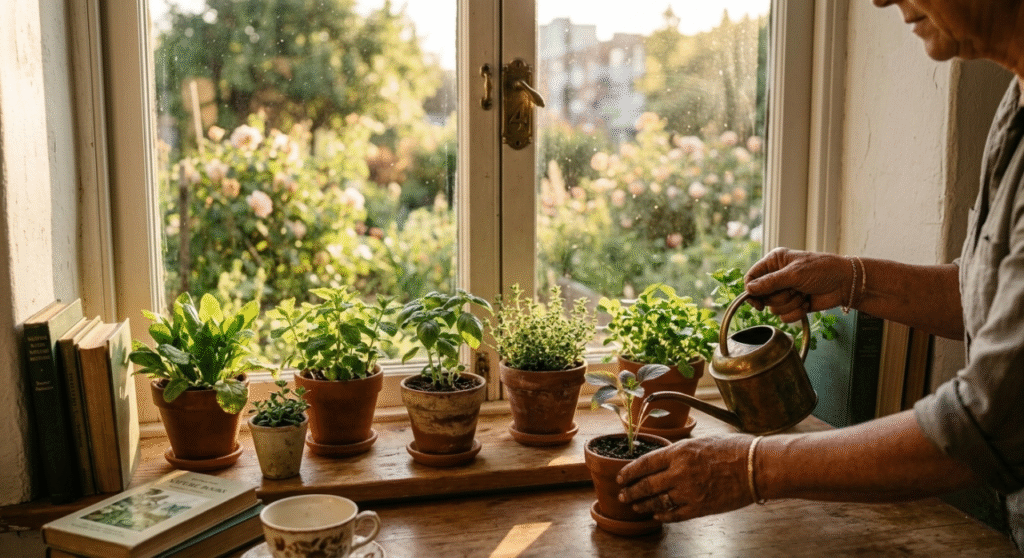
Phase 2 is where therapeutic horticulture begins to intersect with broader healthy lifestyle habits: nutrition, physical movement, daily structure, and restorative rest.
Week 5: Grow What You Eat
One of the most explored intersections between horticultural therapy and healthy living is food. Growing even a small amount of what you eat may shift your relationship with nutrition — not through rules or restriction, but through engagement and curiosity.
- Plant one edible crop: cherry tomatoes, lettuce, green beans, or herbs
- Prepare one meal this week using something from your garden or a local farmers market
- Read the label of one processed food you regularly buy — find a fresh or whole-food alternative
- Start a simple food-mood journal: what you ate and how you felt an hour later

Week 6: The Tending Ritual — Building Automaticity
This is perhaps the most important week for behavior change. A daily tending ritual — short, consistent, predictable — is where the 66-day automaticity window that researchers describe begins to close in your favor.
- Choose a fixed 15-minute window each day — mornings tend to anchor new habits most reliably
- Stack one additional wellness habit onto your tending time: hydration, journaling, breathwork
- Track your daily consistency visually — a paper calendar with checkmarks is highly effective
- Share a photo of your progress with one trusted person to create gentle social accountability

Week 7: Rest Is Part of Growth
People recovering from burnout or living with chronic stress often struggle to rest without guilt. The garden offers a useful perspective: healthy systems require rest periods. Fallow ground is not wasted ground — it is ground being replenished.
- Designate one ‘no-task day’ this week: sit near your plants, but tend to nothing
- Practice a 10-minute body scan meditation near your garden or by an open window
- Track your sleep quality this week and compare notes with your Week 1 baseline
- Create one comfortable, dedicated resting spot near your plants

Week 8: Harvest and Acknowledge Progress
By now, something you planted is ready to be harvested — or at the very least, noticeably alive and growing because of your care. This week is about recognition. Acknowledging progress, however small, is not optional — it’s a key mechanism of sustainable habit formation.
- Harvest something from your garden — even a single herb sprig counts
- Write down 10 things that feel different compared to Week 1
- Prepare or share something from your garden with another person
- Write a short, honest note to your Week-1 self

Phase 3: Bloom — Depth, Community & Sustainability (Weeks 9–12)
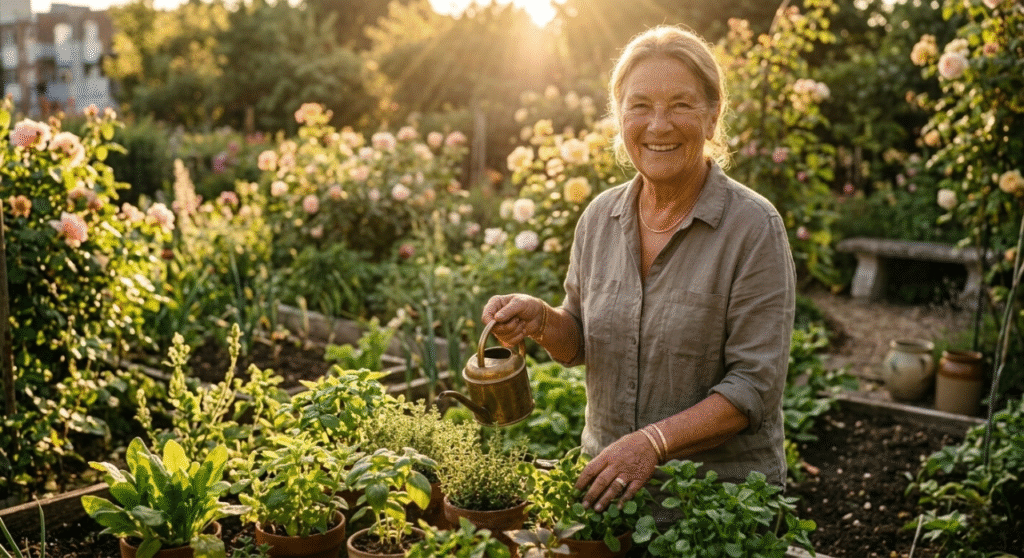
The final phase is about expanding outward: deepening your personal practice, connecting with others, and designing a lifestyle you’ll want to sustain long after Week 12.
Week 9: The Garden as Mindfulness Practice
For many people — particularly those who find traditional meditation inaccessible — gardening serves as a powerful entry point. Focused, repetitive tasks like weeding or pruning share many features with formal mindfulness practice.
- Practice 10 minutes of silent, focused weeding or pruning — treat it as meditation
- Try a slow walking meditation through your garden or a nearby green space
- Introduce one new sensory element: a fragrant herb, a wind chime, or a small water feature
- Begin a gratitude practice specifically connected to your garden and what it has given you

Week 10: Plants, Food, and Gentle Nourishment
This week we go deeper into the connection between what you grow, what you eat, and how you feel. This is not about following a diet — it’s about curiosity, sensory pleasure, and rediscovering the enjoyment of food from the ground up.
- Grow or buy one herb with a traditional wellness association: lavender, chamomile, lemon balm, or holy basil (tulsi)
- Prepare one simple herbal tea or infusion from scratch and enjoy it slowly
- Try one new plant-based recipe using something you’ve grown
- Research the traditional or folk uses of one plant in your garden — just for curiosity
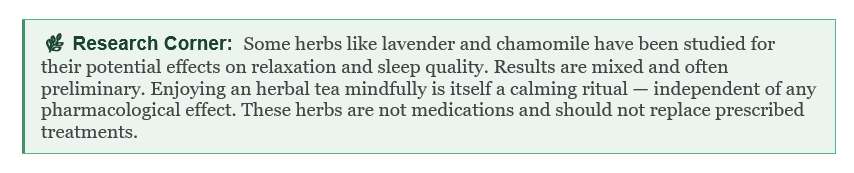
Week 11: Share Your Garden — The Social Dimension
Social isolation is one of the most consistently documented risk factors for poor health outcomes. Gardening, when shared, becomes a vehicle for connection — and research on community gardening suggests the social element may amplify the individual benefits.
- Invite one person to visit your garden or join you in a tending session
- Give something from your garden: a cutting, a small harvest, a homemade herbal tea
- Research local community gardens or therapeutic horticulture programs in your area
- Consider sharing your 12-week journey on social media or with someone you trust

Week 12: Design Your Year-Round Wellness Practice
The final week is about the long game. You now have 12 weeks of lived experience. You’ve moved through seasons of planting, tending, resting, and harvesting. The goal now is to make this sustainable — not as a program, but as a practice.
- Write a simple ‘Garden Wellness Plan’ for the next season: what will you grow, when, and why
- Choose 3 habits from this program to keep as permanent daily anchors
- Plant something that will bloom or fruit in 6–12 months — a commitment to your future self
- Revisit your Week-0 self-assessment answers and write an honest reflection

Adapting This Guide for Specific Needs
Therapeutic horticulture is most effective when it’s adapted to the individual. Here are suggested modifications for common situations. These are general suggestions, not clinical protocols — always coordinate with your healthcare provider.
For Older Adults and Seniors
Prioritize raised beds, tabletop containers, or vertical gardens to reduce bending and strain. Choose lightweight, ergonomic tools. Emphasize the social dimensions — gardening with a companion has been shown to enhance engagement and enjoyment significantly.
For People Experiencing Anxiety or Depression
Start as small as possible. One pot on a windowsill is enough. The goal is not a thriving garden — it’s 10 minutes of gentle presence each day. If some days you only manage to look at your plant and water it, that counts. Consistency matters more than ambition. This guide does not replace professional mental health care.
For Burnout Recovery
Remove all performance pressure from this experience. There is no deadline, no harvest quota, and no version of this program you can fail. Let the rhythm of the garden — its patience, its indifference to urgency — model the pace your nervous system needs right now.
For Those With Limited Mobility
Therapeutic horticulture adapts beautifully to physical limitations. Indoor herb gardens, tabletop planters, adaptive tool handles, and window box gardens all provide the sensory and emotional benefits of the practice. Even arranging and tending to cut flowers in a vase is a valid and meaningful form of engagement.
For People Rebuilding Their Relationship With Food
Growing food can reconnect people to the source and sensory pleasure of eating in a way that feels safe and non-prescriptive. Focus on the sensory qualities — smell, color, texture, taste — rather than nutritional content or calories. If you are working with a dietitian or therapist on eating-related concerns, consider sharing this guide with them and integrating it as a complement to your existing care.
You Don’t Have to Heal Alone — Or All at Once
Therapeutic horticulture is not a cure. It is a practice — quiet, cumulative, and deeply human. Humans evolved alongside plants. We built our earliest medicines from them. We find beauty, nourishment, and meaning in them in ways that transcend any single study or framework.
When you dig your hands into soil, you’re participating in something ancient. The science is still catching up to what gardeners have always known: that tending living things tends to tend to us in return.
Some weeks of this program will feel transformative. Others will feel like just watering a plant. Both are valid. Both count. Growth is rarely visible until it suddenly is.
If this guide resonates with you, please share it. With a friend navigating burnout. A parent who is lonely. A partner dealing with anxiety. A colleague who can’t seem to slow down. The garden has room for all of them.
🌱 Start where you are. Use what you have. Grow what you can.
References & Further Reading
A 2025 systematic review and meta-analysis published in Frontiers in Psychiatry — reviewing 17 studies including four randomized controlled trials — found that therapeutic horticulture interventions were associated with significant reductions in both depression and anxiety symptoms compared to control groups (Wood et al., 2025).”
Full reference:
Wood, C.J., Barton, J., & Wicks, C.L. (2025). Effectiveness of social and therapeutic horticulture for reducing symptoms of depression and anxiety: A systematic review and meta-analysis. Frontiers in Psychiatry, 15, 1507354. https://doi.org/10.3389/fpsyt.2024.1507354
“A widely cited meta-analysis of 22 studies found that engagement in gardening activities was associated with significant reductions in stress, depression, and anxiety, as well as improvements in overall well-being and quality of life (Soga et al., 2017).”
Full reference:
Soga, M., Gaston, K.J., & Yamaura, Y. (2017). Gardening is beneficial for health: A meta-analysis. Preventive Medicine Reports, 5, 92–99. https://doi.org/10.1016/j.pmedr.2016.11.007
“A widely cited meta-analysis of 22 studies found that engagement in gardening activities was associated with significant reductions in stress, depression, and anxiety, as well as improvements in overall well-being and quality of life (Soga et al., 2017).”
Full reference:
Soga, M., Gaston, K.J., & Yamaura, Y. (2017). Gardening is beneficial for health: A meta-analysis. Preventive Medicine Reports, 5, 92–99. https://doi.org/10.1016/j.pmedr.2016.11.007
A 2024 umbrella review and meta-analysis found that gardening and horticultural therapy were associated with improvements in well-being, mental health, and quality of life across multiple populations and settings (Panțiru et al., 2024).”
Full reference:
Panțiru, I., et al. (2024). The impact of gardening on well-being, mental health, and quality of life: An umbrella review and meta-analysis. Systematic Reviews, 13, 45. https://doi.org/10.1186/s13643-024-02457-9
“Research from University College London found that new health-promoting behaviors took an average of 66 days to become automatic — with a range of 18 to 254 days depending on the individual and complexity of the behavior (Lally et al., 2010). This 12-week program (84 days) is deliberately structured to carry most participants past that threshold.”
Full reference:
Lally, P., van Jaarsveld, C.H.M., Potts, H.W.W., & Wardle, J. (2010). How are habits formed: Modelling habit formation in the real world. European Journal of Social Psychology, 40(6), 998–1009. https://doi.org/10.1002/ejsp.674
“According to Attention Restoration Theory (Kaplan & Kaplan, 1989), natural environments may support recovery from directed attention fatigue by engaging what researchers describe as ‘soft fascination’ — an effortless, restorative form of attention that allows mental resources to replenish.”
Full reference:
Kaplan, R., & Kaplan, S. (1989). The Experience of Nature: A Psychological Perspective. Cambridge University Press.
“The biophilia hypothesis (Wilson, 1984) proposes that humans have an evolutionary affinity for living systems — a connection that may help explain why contact with plants and green environments is associated with psychological restoration and stress reduction.”
Full reference:
Wilson, E.O. (1984). Biophilia. Harvard University Press.
